
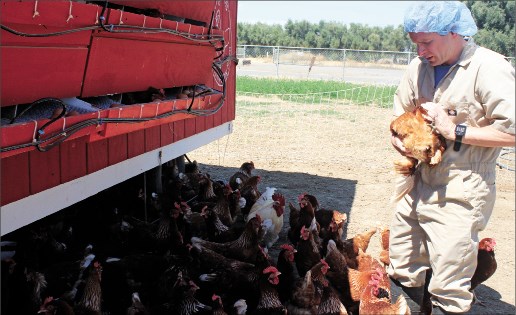
University of California Cooperative Extension poultry specialist Maurice Pitesky checks on the health of egg layers at a research chicken coop in Davis. Pitesky received federal funding in 2013 from the Veterinary Medicine Loan Repayment Progam, which incentivizes veterinarians to take jobs in underserved areas for three years in exchange for payment of up to $75,000 toward their student loans.
Photo/Ching Lee
July 29, 2018 - By Ching Lee - For a veterinarian, Amy Fousek is a rare breed.
She currently operates the only veterinary mobile service in Siskiyou County focused on food animals and equine, and demand for her services continues to soar.
In a region where cattle and horses far outnumber its human residents, the dearth of large-animal vets has been a growing concern for years, rancher Jeff Fowle said. The need has been especially dire in recent years with the loss of several large-animal vets due to death, retirement and other reasons.
"It makes it a challenge when emergencies do arise," Fowle said.
Because of the vet shortage, producers have resorted to helping each other, dealing with problems themselves or hauling sick animals to vets outside the county or state, he added.
Ranchers depend on veterinarians not only to keep their animals healthy and productive, Fowle said, but as a first line of defense against disease outbreaks that could destroy livestock herds and threaten rural economies. Implementation of new rules requiring producers to have a vet's supervision when using medically important antimicrobials has further underscored the need for better access to veterinarians.
But with a shrinking national population of farmers and ranchers, Fowle said fewer people are going into veterinary medicine who also have an agricultural background and interest in livestock.
Today, more than 75 percent of U.S. veterinarians are in private practice treating primarily companion animals, while just 12 percent of the profession devote their business to food animals and equine, according to the American Veterinary Medical Association.
Even though the starting salary of large-animal vets is often comparable to those who treat small animals, specializing in livestock can bring a grueling schedule that requires long-distance travel between farms and ranches. Some vets simply don't want to live in remote places that lack big-city amenities.
To attract large-animal vets, rural communities have sought help from the federal Veterinary Medicine Loan Repayment Program, which provides up to $75,000 toward a vet's student-loan debt in exchange for serving at least three years in shortage areas. The state veterinarian submits nominations of shortage areas to the U.S. Department of Agriculture based on "suggestions from industry partners like the Farm Bureau and the California Cattleman's Association," said California Department of Food and Agriculture spokesman Steve Lyle.
Since 2013, California has submitted 26 nominations, with four awards made. In total, USDA has awarded three-year contracts to 388 licensed veterinarians practicing in 45 states since 2010. Fousek was one of two California recipients in 2015 and is six months away from completing her contract.
Originally from Kansas, Fousek began her veterinary career in San Bernardino County treating horses and later spent four years in Modoc County in a mixed-animal practice. By accepting a job in Siskiyou County, she acknowledged she left a void in a region that has also faced large-animal vet shortages.
"It was kind of sad because I moved from one county to another county and made it worse for the other," she said.
Fowle compared the shortage situation to a sinking ship leaking water from both ends, adding that unless new vets move in from out of state or more students graduate, "all the state is doing is moving large-animal vets around from one area to the next."
Despite the state's four successful recruitments since 2013, other shortage areas remain unfilled. For example, Imperial County has been on the list every year since 2014. Counties such as Plumas, Sierra, Glenn, Colusa, Inyo and Mono also have been listed multiple years.
The problem is not unique to rural regions. The state has been trying to fill a public-service veterinarian position listed as "critical priority" since 2014. The University of California also has been trying to recruit veterinary diagnosticians for its laboratories in Stanislaus, Merced, Tulare and San Bernardino counties, and is on the shortage list this year.
"Part of the challenge is that private industries compete for those people with that skillset," said Pam Hullinger, director of the California Animal Health and Food Safety Laboratory System at UC Davis. "The salaries offered by large companies often are a lot more lucrative than what can be offered through universities or state departments of agriculture."
Many other factors, such as family circumstances, come into play when people choose where they want to work, she added.
When UC Cooperative Extension veterinarian Maurice Pitesky was looking for his first veterinary job in 2013, he said he knew he wanted to work with food animals. Due to the rise of backyard poultry, the state was looking to hire a poultry health veterinarian at the time, but the salary was "terribly low," he said. With his student loans topping $100,000, Pitesky said the loan repayment program was "one of the sweeteners" that made "the job more viable." He was one of two VMLRP recipients in 2013.
He commended the program's flexibility, which allowed him to change what was originally a position at CDFA to the university while still fulfilling the state's need for a poultry specialist focused on food safety, public health and epidemiology.
This flexibility makes sense, he said, because the goal of VMLRP is "not to have you do it for three years and move on to something else" but to match applicants who will go on to build a career in those veterinary positions.
"It checked off a lot of boxes for VMLRP and it allowed me to explore an area of veterinary medicine that I never had that much experience with," he said, adding that his background was not in poultry medicine. "If it weren't for that program, I definitely wouldn't be where I am now."
(Ching Lee is an assistant editor of Ag Alert. She may be contacted at clee@cfbf.com.)
Reprinted with permission: California Farm Bureau Federation