
Click Here for California Fires
August 21, 2024 - As of this morning, 57 large active wildfires are being managed with full suppression strategies nationwide. Current wildfires have burned 1,930,683 acres. 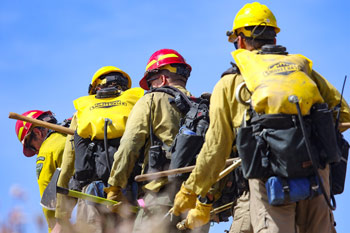 20,858 wildland firefighters and support personnel are assigned to wildfires, including 20 complex and 3 Type 1 incident management teams, 475 crews, 899 engines, 123 helicopters, and four Modular Airborne Fire Fighting Systems, or MAFFS.
Since January 1, 31,400 wildfires have burned 5,426,565 acres. Of these, more than 26,600 wildfires were started by people, and have burned 3.3 million acres. Lightning has ignited about 4,300 wildfires, burning nearly 2.1 million acres.
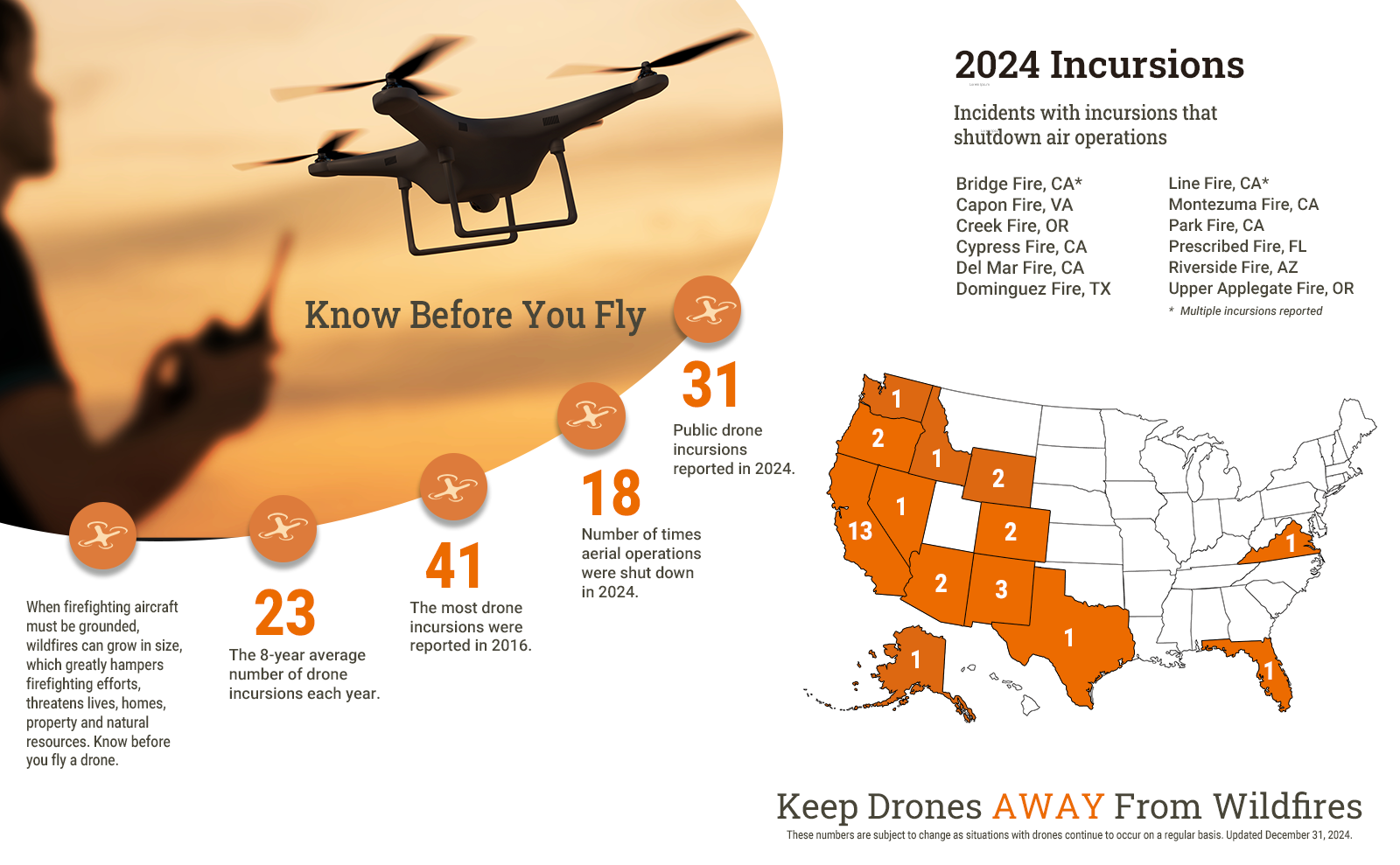
Drone incursions over wildfires continue to rise. So far this year, 16 incursions were reported and air operations were shut down eight times. When firefighting aircraft are grounded because of an unauthorized drone, our personnel lose access to a valuable resource which can affect the safety and efficiency of the overall suppression efforts. Flying a drone near a wildfire puts lives at risk. Please Know Before You Fly and help keep our wildland firefighters in the air and on the ground safe.
Sixty fireline management personnel from Australia and New Zealand are assigned to support large fires in the Northwest Area. For more information about the mobilization of wildland firefighters from Australia and New Zealand visit the international support page.
Two hundred forty-five soldiers from the 14th Brigade Engineer Battalion and the 1st Battalion, 17th Infantry Regiment based out of Joint Base Lewis McChord (JBLM) are deployed in support of wildland fire operations on the Boise National Forest. NIMO (Team 2) is assigned to support the military contingent. To learn more about military mobilizations, visit the military support page.
There are fuels and fire behavior advisories in place for Northwest Texas, Colorado's Front Range and Eastern Wyoming, Southwest Oregon, the region east of the Cascades in Oregon and Washington, and California. Residents, travelers, or workers on their way to any of these states should be advised and familiarize themselves with the elevated risks.
Note: The current reporting from source data for year-to-date figures appears to be underreporting fire acreage in some geographic areas affecting the overall national statistics. Given the very high tempo and scale of national current fire activity, there will be delays in reconciling, especially from areas with large fires and dynamic fire activity. Adjustments may occur as the accuracy of fire locations, mapping and final fire reporting is reconciled.
Breezy and dry southwesterly winds amid RH of 3-15% and poor overnight recovery will continue across much of the Sierra Front into central/eastern Nevada, southern/central Idaho, Wyoming, and western Utah. The strongest winds are likely to shift eastward tomorrow with gusts of 30-50 mph possible in western Utah into much of Wyoming. High-risk significant potential is most likely in eastern Nevada into southern Idaho and western Wyoming where fuels are driest, while low potential remains in Utah due to recent precipitation. However, a few holdovers may emerge in Utah from the windy/dry conditions. Winds will be lighter in the Northwest into northern California as well, with temperatures near to below normal and RH above 20%, including inland areas. Another surge of monsoon moisture will move into Arizona with scattered to widespread wet thunderstorms. Isolated mixed wet/dry thunderstorms will continue across the southeastern half of Utah into the West Slope. Isolated to scattered wet/dry thunderstorms will continue across Montana as well, with increased initial attack likely to continue.
| Number of new large fires or emergency response * New fires are identified with an asterisk |
6 | States currently reporting large fires: |
| Active large fires | 57 | |
| Acres from active fires | 1,930,683 | |
| Fires contained | 7 |
Year-to-date statistics
| 2024 (1/1/24-8/21/24) | Fires: 31,400 | Acres: 5,426,565 |
| 2023 (1/1/23-8/21/23) | Fires: 36,672 | Acres: 1,772,898 |
| 2022 (1/1/22-8/21/22) | Fires: 43,427 | Acres: 5,967,808 |
| 2021 (1/1/21-8/21/21) | Fires: 41,046 | Acres: 4,440,787 |
| 2020 (1/1/20-8/21/20) | Fires: 38,013 | Acres: 2,966,224 |
| 2019 (1/1/19-8/21/19) | Fires: 31,677 | Acres: 3,844,677 |
| 2018 (1/1/18-8/21/18) | Fires: 41,563 | Acres: 6,000,149 |
| 2017 (1/1/17-8/21/17) | Fires: 42,977 | Acres: 6,479,177 |
| 2016 (1/1/16-8/21/16) | Fires: 38,686 | Acres: 4,161,814 |
| 2015 (1/1/15-8/21/15) | Fires: 41,599 | Acres: 7,421,077 |
| 2014 (1/1/14-8/21/14) | Fires: 37,494 | Acres: 2,656,188 |
10-year average Year-to-Date
| 2014-2023 | Fires: 39,105 | Acres: 4,527,077 |
Source: NIFC