
Click Here for California Fires
September 10, 2024 - As of this morning, active wildfires have burned 2,247,356 acres. Seven new large incidents were reported, bringing the total to 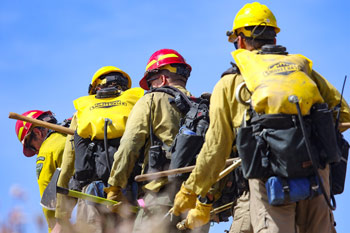 71 large active wildfires being managed with full suppression strategies. Currently 24,163 wildland firefighters and support personnel are assigned to incidents, including 23 complex and 5 type 1 incident management teams, 532 crews, 1,371 engines, and 151 helicopters.
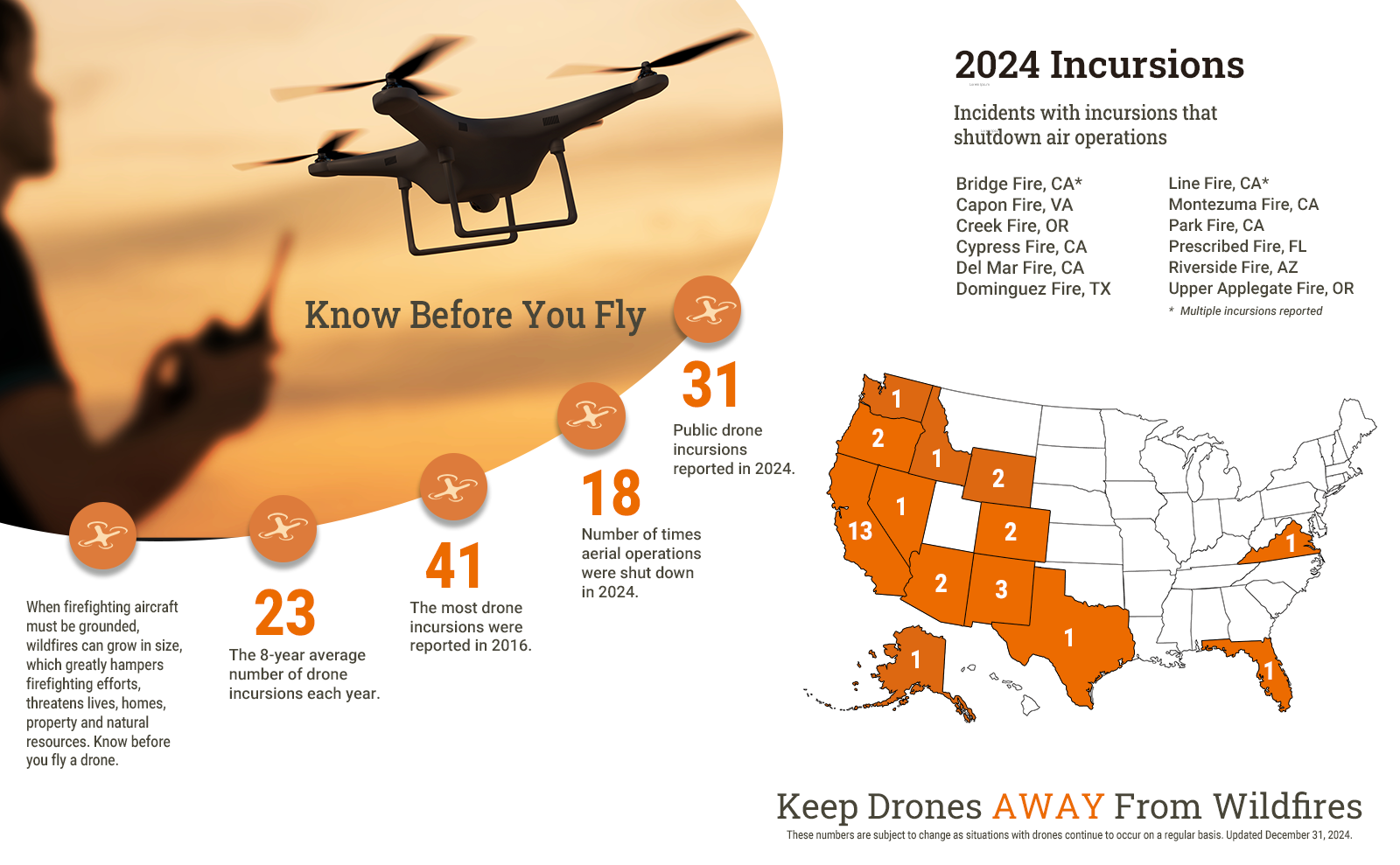
So far in 2024, 21 uncrewed aircraft systems, or UAS, incursions have been reported near wildfires. When an unauthorized drone is detected flying over or near a wildfire, wildland fire managers may have to ground all airtankers, helicopters, and other aerial firefighting resources until they can confirm that the drone has left the area and they feel confident that it won’t be coming back. Aircraft operations were shut down 10 times this year due to UAS incursions. Always check for and abide by temporary flight restrictions near wildfires. Know before you fly, the safety of our wildland firefighters in the air and on the ground depends on it.
A huge thank you to the support staff that traveled around the planet from Australia and New Zealand to support U.S. firefighting efforts! The last members of these crews are completing their assignments and will be returning to their home countries. For more information about international mutual aid on fires, visit the international support page.
Two hundred forty-five soldiers from the 14th Brigade Engineer Battalion and the 1st Battalion, 17th Infantry Regiment based out of Joint Base Lewis McChord (JBLM) are deployed in support of wildland fire operations on the Boise National Forest. NIMO (Team 2) is assigned to support the military contingent. To learn more about military mobilizations, visit the military support page.
Note: Given the very high tempo and scale of national fire activity over the past few months, there have been delays in reconciling actual acreage burned with entries into the reporting systems, especially from areas with large fires and dynamic fire activity. Adjustments are occurring as the accuracy of fire locations, mapping and final fire reporting is reconciled.
A deep upper-level trough over the Pacific Ocean will start to near the Pacific Coast. This will start a pattern change that will continue through the end of the week. Ahead of this system, winds across the Intermountain West will continue to gust 20 to 30 mph through the afternoon. Latest model runs show Cascade Gap winds increasing ahead of the trough. RH across much of the West will remain low at 5 to 20%, though west of the Cascades humidity will start to increase substantially only dropping to 30 to 40%. The heat wave will continue through the Central Valley and into Arizona with highs remaining 100 to 110 degrees. The High Plains will continue to see above normal temperatures, with highs on the Northern Plains up into the mid to upper 90s. Some lingering monsoonal moisture caught under the ridge will keep some isolated to scattered mixed wet/dry showers and thunderstorm going around the Four Corners region. The cold front associated with the incoming trough will be moving through the Northwest overnight. In the east with the low moving out of eastern Canada and the flat ridge in the west spreading farther east, expect the heat to spread across the Midwest and as far east as the Appalachians. RH will continue to be lower across the Southern Plains into the Ohio and Tennessee valleys from 20 to 30%. Winds in the High Plains to the Western Great Lakes will gust 20 to 30 mph, otherwise winds will generally remain light. Tropical Storm Francine in the western Gulf will remain over the Gulf, but stronger winds and increased rain will continue to impact the South Texas Coast.
| Number of new large fires or emergency response * New fires are identified with an asterisk |
7 | States currently reporting large fires: |
| Total number of active large fires Total does not include individual fires within complexes. |
71 | |
| Acres from active fires | 2,247,356 | |
| Fires contained | 0 |
Year-to-date statistics
| 2024 (1/1/24-9/10/24) | Fires: 36,040 | Acres: 6,918,822 |
| 2023 (1/1/23-9/10/23) | Fires: 41,944 | Acres: 2,191,140 |
| 2022 (1/1/22-9/10/22) | Fires: 43,231 | Acres: 6,621,969 |
| 2021 (1/1/21-9/10/21) | Fires: 43,997 | Acres: 5,266,550 |
| 2020 (1/1/20-9/10/20) | Fires: 41,794 | Acres: 5,496,248 |
| 2019 (1/1/19-9/10/19) | Fires: 36,142 | Acres: 4,251,231 |
| 2018 (1/1/18-9/10/18) | Fires: 47,303 | Acres: 7,068,928 |
| 2017 (1/1/17-9/10/17) | Fires: 48,082 | Acres: 8,159,989 |
| 2016 (1/1/16-9/10/16) | Fires: 42,280 | Acres: 4,745,957 |
| 2015 (1/1/15-9/10/15) | Fires: 45,198 | Acres: 8,671,828 |
| 2014 (1/1/14-9/10/14) | Fires: 39,137 | Acres: 2,814,004 |
10-year average Year-to-Date
| 2014-2023 | Fires: 43,295 | Acres: 5,473,505807 |
Source: NIFC