
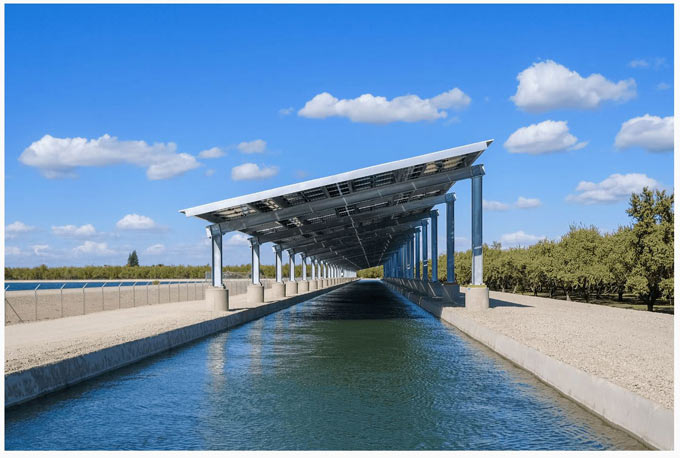
Pilot project will explore a new approach to water conservation and renewable energy in the Central Valley
What you need to know: With construction complete, California is now testing a new approach to water conservation and clean energy through Project Nexus — a $20 million pilot project in the Central Valley that places solar panels over canals. This first-of-its-kind project will help the state evaluate how solar infrastructure can reduce water loss from evaporation, generate renewable energy, and improve overall system efficiency.
April 30, 2026 - SACRAMENTO – On Wednesday, Governor Newsom announced the launch of California’s first-of-its-kind solar-covered canal, a project that will explore how this approach generates clean electricity, keeps water from evaporating before it ever reaches a farm or a faucet, and, if scaled further, help strengthen the state’s water infrastructure to withstand a hotter, drier future.
Thanks to a $20 million investment from Governor Newsom and the Legislature, the completion of this innovative solar infrastructure, Project Nexus, will test how solar panels installed over irrigation canals may contribute to clean energy generation, evaporation reduction, and water conservation in the Central Valley.
I’m proud of California for continuing to lead with innovative, outside-the-box solutions to our climate crisis — including this first-of-its-kind solar-covered canal in the Central Valley. We remain committed to investing in clean energy and developing cutting-edge technologies to address climate and water challenges. California is showing the world what’s possible when innovation meets action.
Governor Gavin Newsom
The pilot project represents a unique public-private and academic partnership between the California Department of Water Resources, Turlock Irrigation District (TID), solar development firm SolarAquaGrid LLC, and the University of California, Merced — all working together to pioneer innovation in Turlock.
Project Nexus will measure how much clean energy the solar panels generate, how much water is saved by reducing evaporation, whether water quality improves, and whether covering canals reduces the cost of maintaining them, including by limiting the vegetation growth, and potentially cutting down millions of dollars TID spends annually on maintenance.
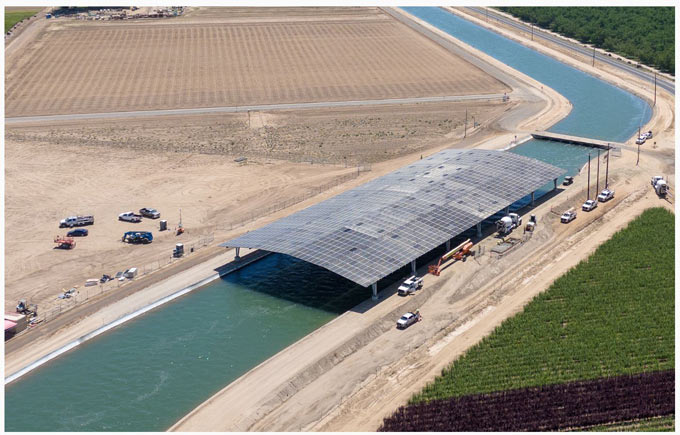
“DWR appreciates the opportunity to test an exciting idea in real-world conditions and learn more about how we might combine energy generation and reliable water deliveries without expanding our development footprint,” said John Yarbrough, DWR Deputy Director for the State Water Project. “We look forward to learning even more about how the solar-over-canals concept may support California’s clean energy goals and long-term drought resilience.”
The California way
As Governor Newsom said in his State of the State address in January, California has spent 175 years finding a way to build the future over and over — to meet the challenges before us with action. As a global economic powerhouse, the Golden State has a long history of pioneering the technologies and solutions that define generations of Californians. Today, climate change is pushing California to reimagine our infrastructure for a hotter, drier future. By integrating solar generation into existing water delivery systems, Project Nexus demonstrates how, through innovative research and application, California can:
- Potentially reduce water loss from evaporation
- Generate clean, renewable energy
- Explore opportunities to improve system efficiency and reduce maintenance costs
- Put existing canal surface area to work generating clean energy
The science behind the project is compelling: a UC Merced analysis estimated that putting solar panels over California’s open canals could save billions of gallons of water annually.
Project Nexus reflects California’s continued leadership in developing practical, innovative solutions that support clean energy and water resilience — and help advance the state’s long-term water planning goals, including the 2028 Water Plan.
Trump stalls clean energy future
Donald Trump continues to weaponize the federal government to attack clean energy projects in favor of fossil fuels — an agenda that’s costing ratepayers billions, weakening grid reliability, and killing good-paying jobs. He has falsely claimed that wind turbines are ‘driving the whales crazy’ and killing off birds. He has cancelled wind energy projects in California and forced companies to bend the knee and invest in oil and gas infrastructure instead. The administration continues to cut hundreds of millions of dollars from federal renewable energy and efficiency programs that target solar and wind power. To make matters worse, Trump’s tariffs are raising the cost of grid equipment, including transformers, switchgears, circuit breakers, and wires and cables. While Donald Trump takes the nation in the opposite direction on its energy policy, California is doubling down on building the clean energy economy of the future.
California’s clean energy leadership
Since the beginning of the Newsom administration, California has added nearly 17,000 megawatts (MW) of battery storage to our energy system, a 2,100% increase — and over 30,000 megawatts of new resources that’s redefining grid reliability and advancing the state’s clean energy transition.
California welcomed nearly $1 billion in clean-tech investments with UK Octopus Energy in 2026 — continuing its commitment to win the global clean energy economy and build a safe, affordable energy future.
In 2023, California was powered by two-thirds clean energy, making it the largest economy in the world to achieve this level. The state ran on 100% clean electricity for part of the day almost every day last year. California now has 33% of the storage capacity estimated to be needed by 2045 to reach 100% clean electricity. The Golden State is showing the world it is a clean energy powerhouse.
Source: Office of the Governor