
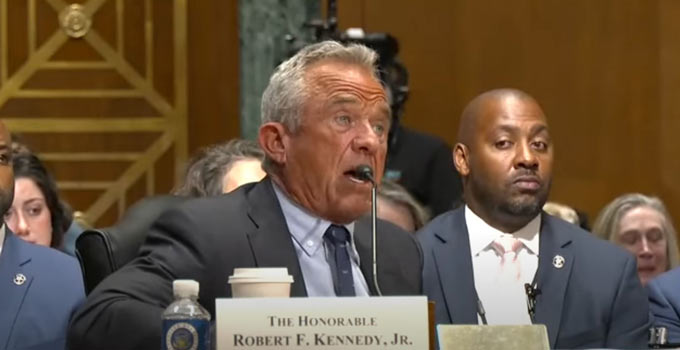
Secretary of Health and Human Services (HHS) Robert F. Kennedy, Jr. speaks at a Senate Finance Committee Hearing
MAHA Voters Are More Supportive Than Other Voters of the Trump Administration's Food and Vaccine Policy Though Less Than 1 in 3 "Strongly Approve"
May 6, 2026 - Chemical food additive and pesticide concerns associated with the Make America Health Again (MAHA) movement are shared broadly across the public. But when it comes to voters, health care costs are a higher priority and bigger motivator, even among MAHA supporters, a new KFF Health Tracking Poll finds.
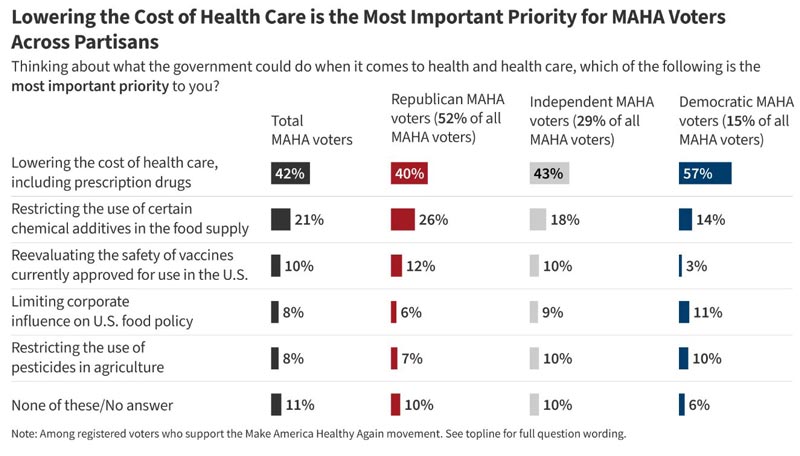
When asked to identify their most important health priority for government to address, far more MAHA-supporting voters identify lowering the cost of health care (42%) than other issues more closely associated with the movement, such as restricting the use of chemical additives in the food supply (21%), reevaluating the safety of vaccines (10%), limiting corporate influence on food policy (8%), or restricting the use of pesticides in agriculture (8%).
At least half of MAHA voters also say that the cost of health care will have a “major impact” on their decision to vote (51%) and which party’s candidate they will support (56%) in the upcoming midterms. That’s more than say the same about vaccine policy (36% say it will impact their decision to vote, 40% say it will impact which candidate they will support) or food safety (43% say it will impact their decision to vote, 45% say it will impact which candidate they will support), two issues closely aligned with MAHA, a movement promoted by the Trump administration and by Health and Human Services (HHS) Secretary Robert F. Kennedy Jr.
Overall, about four in ten (41%) adults—and a similar share of voters (43%)—say they are supporters of the MAHA movement, with support closely tied to partisanship and support of President Trump’s Make America Great Again (MAGA) movement.
Among voters who support MAHA, about half (52%) identify as Republicans, 29% identify as independents, and about one in seven (15%) identify as Democrats. A majority (56%) of MAHA voters identify as Republican or Republican-leaning and support the MAGA movement. The pattern of prioritizing health costs ahead of other MAHA issues is consistent across these partisan subgroups.
Other MAHA Health Concerns Are Shared by the Broader Public
Majorities of the public say there is not enough regulation of chemical additives in food (75%) or of pesticides used in agriculture (64%)—including majorities across partisans, among MAHA supporters, and those who do not support the movement.
Most of the public—across partisans and MAHA supporters—also share a distrust of federal health agencies and food and drug industries:
- Four in ten or fewer adults say they have at least some confidence in the U.S. Centers for Disease Control and Prevention (CDC: 40%), the U.S. Food and Drug Administration (FDA: 36%), or the U.S. Environmental Protection Agency (EPA: 36%) to act independently without interference from outside interests. Democrats are more likely than Republican or independent adults to trust the CDC, but partisan differences largely disappear for the FDA and EPA.
- Less than half of U.S. adults trust agricultural companies (40%), food and beverage companies (25%), or pharmaceutical companies (21%) to act in the public’s best interest. Low levels of trust in these industries are also present across partisans.
About 1 in 3 MAHA Voters Strongly Approve of HHS Secretary Kennedy’s Job Performance
MAHA voters approve more than other voters of how the Trump administration is handling food policy, including chemical additives and pesticides (72% vs. 27%), and vaccine policy (67% vs. 17%), as well as how HHS Secretary Robert F. Kennedy Jr. is handling his job (69% vs. 17%). However, less than one-third of MAHA voters “strongly approve” of the Trump administration on food policy (32%) and vaccine policy (29%) and of the HHS Secretary’s handling of his job (32%)—while similar shares of MAHA voters disapprove in all three areas. This is a fairly tepid rating for a group that aligns with Kennedy’s signature movement.
Overall, voters are evenly divided on whether they trust Democrats (31%) or Republicans (27%) to handle the safety of food additives and pesticides, and a similar share (31%) gives neither party the advantage on this issue. Meanwhile, the Democratic Party holds the advantage over the Republican Party in who voters trust to handle vaccine policy (41% vs. 25%) and ensure that federal health agencies act independently without corporate influence (33% vs. 24%).
Designed and analyzed by public opinion researchers at KFF, this survey was conducted April 14-19, 2026, online and by telephone among a nationally representative sample of 1,343 U.S. adults in English and in Spanish. The margin of sampling error is plus or minus three percentage points for the full sample. For results based on other subgroups, the margin of sampling error may be higher.
Source: KFF