
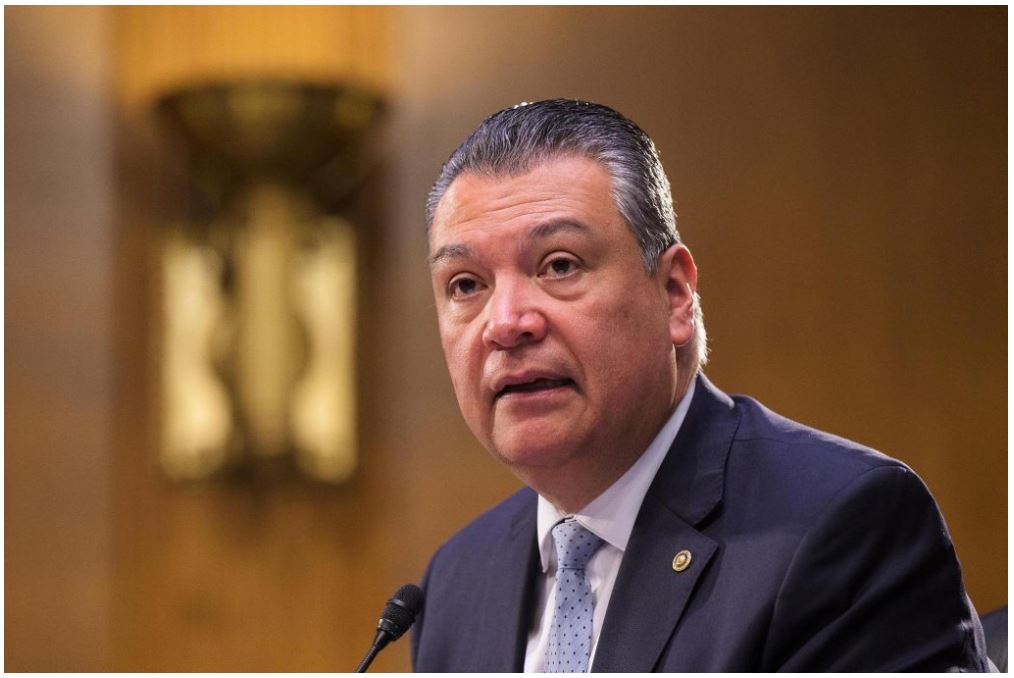
May 16, 2026 - WASHINGTON, D.C. — On Friday, U.S. Senator Alex Padilla (D-Calif.), Ranking Member of the Senate Judiciary Immigration Subcommittee, joined Senators Edward J. Markey (D-Mass.) and Jeff Merkley (D-Ore.), to lead their Democratic colleagues in pushing back on the Department of Homeland Security’s (DHS) dangerous budget proposal which includes the development of “smart glasses” for its immigration enforcement officers and agents.
Senator Alex Padilla (D-Calif.)
In a letter to DHS Secretary Markwayne Mullin, the Senators warn that these smart glasses would allow DHS officers and agents to quickly identify individuals in public by covertly taking their photo and running it through biometric identification systems — such as facial recognition software — threatening the privacy and civil liberties of every person in the United States. These biometric smart glasses are the latest example of the Trump Administration’s growing surveillance state, which is intended to silence dissent and intimidate people in communities across the country.
“Given DHS’s record during the Trump administration of exploiting surveillance technologies, we are deeply concerned that smart glasses will be abused by this administration,” wrote the Senators. “Over the past year, DHS has deployed biometric identification tools — including facial recognition technologies — to identify individuals engaged in protest activity, intimidate them, and deter lawful dissent. The Trump administration seems to relish these practices, which endanger the core democratic right to challenge the government without fear of punishment. Smart glasses would provide yet another opportunity for DHS to extend its surveillance capabilities and intimidate individuals across the country.”
In addition to Padilla, Markey, and Merkley, the letter was also signed by U.S. Senators Adam Schiff (D-Calif.), Cory Booker (D-N.J.), Brian Schatz (D-Hawaii), Ron Wyden (D-Ore.) Chris Murphy (D-Conn.), Chris Van Hollen (D-Md.) and Richard Blumenthal (D-Conn.).
Earlier this year, Padilla and his Democratic colleagues called for an investigation of DHS agencies, including ICE, over warrantless purchases of Americans’ location data.
Padilla has strongly opposed President Trump’s cruel and indiscriminate mass deportation agenda and denial of basic services for detained individuals. In March, Padilla opposed Mullin’s confirmation to be Secretary of Homeland Security. Padilla has also confronted former DHS Secretary Kristi Noem on the Trump Administration’s cruel mass deportation and detention campaign, attacks on legal immigration, and efforts to meddle in the upcoming 2026 midterm elections. Padilla has attended a series of bicameral spotlight forums to denounce DHS officers and agents’ unlawful arrests of U.S. citizens, violent tactics, and disproportionate use of force. He also co-led a letter denouncing the Trump Administration’s stops, arrests, detentions, and deportations of U.S. citizens.
Full text of the letter is available here and below:
Dear Secretary Mullin,
The Department of Homeland Security’s (DHS) 2027 budget proposal to develop “smart glasses” for biometric identification presents a grave threat to the privacy and civil rights of people across the United States. DHS’s proposed smart glasses could allow its agents to identify individuals, including U.S. citizens, in real time by covertly collecting their biometric information — for example, through a facial scan — without their knowledge or consent. Given the Trump Administration’s record of abusing surveillance technologies, DHS would be able to weaponize smart glasses and turn them into an authoritarian tool against anyone who speaks out against President Trump. DHS should immediately abandon any plans it has to develop this technology.
The Trump administration’s proposal to develop smart glasses represents a chilling expansion of its surveillance state. According to DHS’s own budget documents, the Department seeks $7.5 million to develop new technologies and analytics tools for U.S. Immigration and Customs Enforcement (ICE) and U.S. Customs and Border Protection (CBP), including smart glasses to “equip agents with real-time access to information and biometric identification capabilities in the field.” Smart glasses are designed to be indistinguishable from regular glasses but include small cameras, which would enable ICE and CBP officers to capture thousands of images of faces each day — without the subjects’ knowledge or consent — and identify them with biometric recognition technology. Furthermore, there is no guarantee that data collected would only be used for immigration enforcement. In essence, DHS wants to provide its officers with a tool to quickly and covertly identify members of the public, a breathtaking expansion of its technological capacity to surveil the American people.
The dangers here are obvious. This technology can easily be co-opted to support the wrongful arrest, detainment, and deportation of U.S. citizens or other lawful residents and immigrants, as the Department has already done since the start of the second Trump administration. An ICE officer could use smart glasses to identify and later target peaceful protesters, even exploiting that information to create a database of President Trump’s political opponents. A CBP officer wearing smart glasses in the field could covertly scan thousands of faces a day, cross referencing them against social media and government databases to flag journalists, activists or critics for detention. Meanwhile, immigration enforcement officers continue to use face coverings to avoid being identified in public, underscoring the irony of agents’ desire for privacy while simultaneously using privacy invasive technology. Such frictionless, real-time surveillance is un-American. Every person in the United States has the right to move through daily life without fear that the federal government is tracking, scanning, and cataloguing their every step.
Given DHS’s record during the Trump administration of exploiting surveillance technologies, we are deeply concerned that smart glasses will be abused by this administration. Over the past year, DHS has deployed biometric identification tools — including facial recognition technologies — to identify individuals engaged in protest activity, intimidate them, and deter lawful dissent. For example, in Portland, Maine, an ICE officer recorded a protester on video and told her that her information would go into a so-called “domestic terrorist” database. In a separate incident, an ICE agent, without consent, photographed a Minneapolis woman documenting ICE activity in her neighborhood and then recited her personal information to her, including her address — a clear intimidation tactic. The woman later described being terrified by the encounter. The Trump administration seems to relish these practices, which endanger the core democratic right to challenge the government without fear of punishment. Smart glasses would provide yet another opportunity for DHS to extend its surveillance capabilities and intimidate individuals across the country.
DHS’s funding request for smart glasses continues the Administration’s unaccountable expansion of its surveillance infrastructure under the banner of national security. Since the start of President Trump’s second term, we have repeatedly sounded the alarm on DHS’s abuses of its growing arsenal of surveillance tools. We, individually or as a group, have written oversight letters requesting detailed information about ICE’s “Mobile Fortify” facial recognition application; CBP’s nationwide network of license plate readers; DHS’s use of predictive algorithms to identify national security threats; DHS’s monitoring of social media information; and DHS’s deployment of Predator drones to observe protesters. DHS or its subcomponents have refused to provide a meaningful response to any of these inquiries. The pattern is unmistakable: DHS continues to introduce powerful new surveillance technologies while stonewalling legitimate congressional oversight. That is unacceptable.
Given the serious risk to the privacy and civil liberties of Americans, DHS should abandon its plans to develop and deploy smart glasses. In the meantime, the Department owes the American people answers about its plans to deploy such an invasive and dangerous technology. Please respond to the following questions in writing by June 4, 2026:
1. Please describe all evaluations DHS has conducted regarding the civil rights and privacy implications of deploying smart-glasses technologies. In your response:
- Identify and describe any assessments of how such technologies would affect the privacy rights of individuals whose images or data may be captured, including bystanders and other non-targets.
- Describe any analysis of whether biometric identification through smart glasses could chill lawful activity protected by the First Amendment.
- State whether DHS has evaluated the risks of misidentification, disparate impact, or other discriminatory outcomes associated with these technologies, and provide any findings.
- Describe any safeguards DHS has considered or adopted to prevent misuse by DHS personnel or contractors.
- Identify any Privacy Threshold Analyses, Privacy Impact Assessments, or third party audits conducted or commissioned in connection with smart-glasses technologies, and provide copies. If none have been conducted, state whether DHS intends to do so and provide a timeline for completion and public release.
2. Please describe DHS’s anticipated practices regarding the collection, use, and retention of biometric data in connection with any deployment of smart glasses. In your response:
- Identify the categories of biometric data that would be collected and the legal authorities supporting such collection.
- Describe how DHS would provide meaningful notice and obtain consent from individuals whose biometric data may be captured, including bystanders and nontargets.
- Specify applicable retention periods and the policies governing data minimization, deletion, and access controls.
- State whether individuals will be able to request deletion of their biometric data and, if so, describe the procedures that will govern such requests and ensure timely and complete compliance.
- Explain how DHS will ensure compliance with applicable state biometric privacy laws, including requirements related to notice, consent, retention, and restrictions on data sharing.
3. Please identify any third parties with which DHS has contracted or otherwise partnered to develop, test, or deploy smart-glasses technologies, and describe the scope and terms of those engagements.
Thank you for your attention to this important matter.
Sincerely,
Source: Senator Alex Padilla