
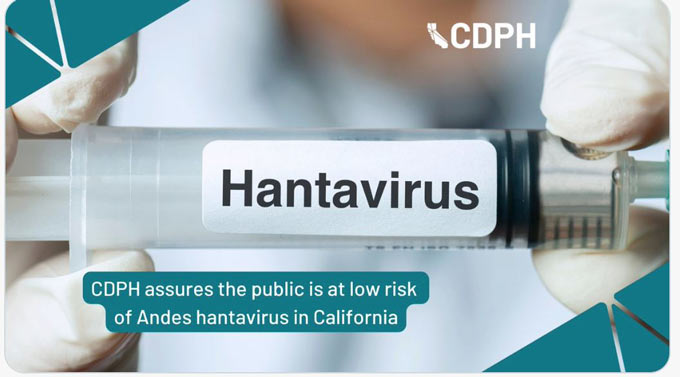
Risk to the Public is Extremely Low, CDPH Coordinating with CDC and Local Public Health
What You Need to Know: CDPH is closely coordinating with federal and local health partners following notification that California residents were aboard the MV Hondius, a cruise ship that experienced an outbreak of Andes hantavirus. One individual has returned to the state and is in contact with local public health officials regarding their exposure. The risk to the public remains extremely low.
May 9, 2026 - SACRAMENTO – The California Department of Public Health (CDPH) is closely coordinating with federal and local health partners following CDC notification that California residents were aboard the cruise ship MV Hondius, which is experiencing an outbreak of Andes hantavirus. One of the individuals has returned home and is in contact with local public health officials. At least one other remains on board the ship.
Public health protocol is to do daily symptom monitoring and reporting. As there are no known cases of Andes hantavirus infection from people without symptoms, and any spread has usually been limited to people with prolonged close contact with an ill person with this virus, the risk to the general public in California is extremely low.
"We understand that news of an unusual outbreak can be concerning," said Dr. Erica Pan, State Public Health Officer and CDPH Director. "At this time, local, state, national and global public health partners are working together to assess and care for people who may have been exposed and prevent spread of the virus. Unlike influenza and COVID-19, years of experience in South America have shown that this Andes hantavirus rarely spreads between people."
The state will continue to coordinate closely with the federal government and local health departments to monitor the situation and provide testing support to this infectious disease response.
CDPH Monitoring
Local health officials are in contact with the one returned passenger. At this time, public health protocol includes daily temperature checks and assessment for any symptoms consistent with hantavirus, and direction to modify activities.
To protect privacy, no additional identifying information about the returned passenger will be released.
CDPH has been notified by the federal government that a second California resident is still on board the MV Hondius. As of May 8, CDPH has been informed that there are no ill passengers on board, and the federal government is working to secure the safe return of all United States passengers.
CDPH Lab Supporting Federal Response
California is supporting the national response by fast‑tracking clinical testing capacity for Andes hantavirus samples at its Viral and Rickettsial Disease Laboratory (VRDL). CDPH VRDL is the only public health laboratory in the U.S. with a validated diagnostic hantavirus PCR assay specifically for Sin Nombre virus (SNV), the type of hantavirus that is native to California and North America. This test can also detect other hantaviruses, including Andes virus, which is responsible for the cruise ship outbreak.
CDPH VRDL is providing consultation to other state public health laboratories across the country to support hantavirus PCR testing capacity.
About Hantavirus & Transmission Risk
Hantavirus is a group of viruses that spread through the urine, droppings (feces), and saliva of wild rodents. Hantaviruses include both the Sin Nombre and Andes virus strains. The Andes hantavirus identified in this cruise ship outbreak is found in the southern Andes region of Argentina and Chile. Andes hantavirus has also been associated with rare human‑to‑human transmission after close, prolonged contact with an ill infected person.
Andes hantavirus is different than the Sin Nombre hantavirus, which is native to California and North America. Sin Nombre hantavirus has not been associated with person-to-person transmission.
From 1980 to 2025, 99 California residents have been diagnosed with Sin Nombre hantavirus infection.
Hantavirus Pulmonary Syndrome (HPS) is a rare but severe respiratory illness that can develop following exposure. Early symptoms resemble influenza, can include gastrointestinal symptoms, and can progress rapidly to life‑threatening respiratory distress. The fatality rate is approximately 30 - 40 percent. There is no antiviral treatment for hantavirus and HPS typically needs aggressive critical medical supportive care.
More information is available on CDPH'shantavirus website and from the CDC.
Source: CDPH