



Image by Moira Nazzari from Pixabay
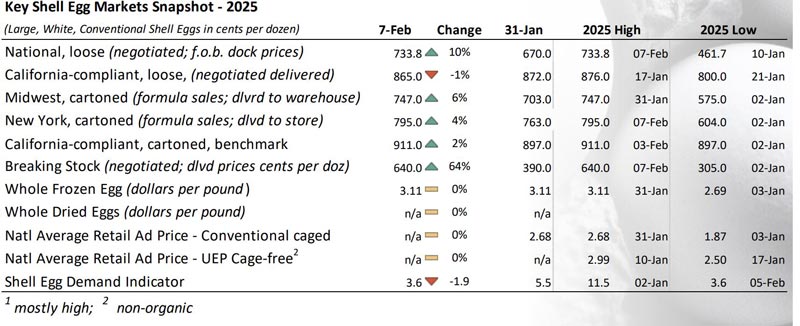
February 10, 2025 - Negotiated wholesale prices for graded loose eggs continued to move higher with a firm undertone. Demand is in a full range with retail business seeing the most interest. Offerings remain very light with little chance for improvement in the near-term as highly pathogenic avian influenza (HPAI) continues to impact productive flocks. The supply situation, while showing some improvement, still only ranges from very light to moderate – largely due to less pull on the supply over the past week than in increased production. Trading is active for available offerings. Prices for national trading of trucklot quantities of graded, loose, White Large shell eggs increased $0.64 to $7.34 per dozen with a higher undertone. The wholesale price on the New York market for formula trading of Large cartoned shell eggs delivered to retailers rose $0.32 to $7.95 per dozen with a firm undertone. In the major Midwest production region, wholesale prices for Large, white, shell eggs delivered to warehouses increased $0.44 to $7.47 per dozen with a higher undertone while prices paid to producers for Large cartoned shell eggs increased $0.09 to $7.25 per dozen. The California benchmark for Large shell eggs gained $0.14 to $9,11 per dozen with a fully steady undertone. Delivered prices on the California-compliant wholesale loose egg market decreased $0.07 to $8.65 per dozen with a mostly steady undertone.
Demand for shell eggs in the wholesale market eased slightly as the shell egg ad feature conducted by a major national chain in the last ad cycle expired mid-week, providing some relief to marketers still struggling to build a sufficient level of stocks to meet their business needs. Overall demand remains strong relative to supply. Outbreaks of HPAI in commercial table egg layer flocks continue into February with new cases reported in Ohio and the first case reported in Pennsylvania. This further acerbates the supply situation, particularly in Eastern markets. The timing and scope of HPAI outbreaks has created an imbalance in the nation’s supply of table shell eggs with supplies short in some regions while barley adequate in others. Marketers whose regular suppliers have been impacted are working to find new short-term supply sources in a very competitive market atmosphere. For now, shell egg availability remains limited and inconsistent in many retail markets with many affected grocers employing steps to limit consumer purchasing to stretch their existing supplies including limiting or ending promotional activity, placing limits on units purchased per shopping trip, and holding prices at record or near-record highs to dampen demand. Demand from egg products manufacturers rose sharply this week as many were unable to continue their efforts to stretch dwindling supplies to maintain adequate production levels. As a result, many were forced into a very competitive spot market and price levels quickly advanced to close the gap between breaking stock and carton stock.
Feature activity for conventional caged Large shell eggs is not recorded this week as grocers have limited shell egg advertising to maintain supplies. The pace of specialty shell egg featuring remains very limited and largely focused on organic types. Feature activity for UEP-defined cage-free shell eggs is not recorded this week and the price spread on feature between 12-packs of Large caged eggs and UEP cage-free eggs is not calculated this week. Grocers continue to avoid incentivizing shell egg movement as they work to maintain a consistent supply to their customers in the current environment.
The overall shell egg inventory increased just over one percent while the national inventory of Large class shell eggs was about unchanged. Stocks of Large shell eggs in the key Midwest region posted an 8% gain, a possible sign that supply may be recovering. The inventory share of Large class shell eggs remained at a 50% share of all shell egg stocks on inventory at the start of the week. Stocks of cage-free eggs were down 2% while stocks of nutritionally-enhanced eggs increased nearly 21% largely to supply retail featuring that broke late in the ad cycle last week extending into this week. Stocks of organic shell eggs gained 14.5% to support breaking retail featuring this cycle. Breaking stock inventory declined 4.5% as breakers continue to draw on stocks to operate at reduced levels given continued very limited spot market offerings. Total estimated table egg production is about unchanged from last week and about one percent higher from last year to a yearto-year deficit the equivalent of 5.2 million cases in total.
Wholesale prices for breaking stock in the Central States increased sharply, adding $2.50 per dozen to $6.40 per dozen, its highest recorded level. Demand is limited with very light offerings and very light to, at times, moderate supplies. Movement is moderate. Breakers had been working to avoid entering the spot market but, after exhausting all efforts, were forced to compete for very limited offerings and price levels quickly narrowed the gap with table eggs for in-shell use. Breaking schedules are reduced and running 3% behind year ago levels. The volume of eggs processed last week decreased a half percent while the share of weekly table egg production remains at 28%. Production of whole egg was down about 2.5% while production of whites declined 6% and yolks declined by one percent. Production of dried egg decreased 5% and inedible egg production increased 8%. Breaking yields without inedible declined just over three quarters of a pound to 41.45 pounds per case broken.
Wholesale prices for certified liquid whole eggs are sharply higher with a firm undertone. Demand is good to very good for light to very light offerings and trading is moderate to active. Wholesale prices on frozen eggs are too few to report with frozen whole egg last quoted at $3.11 per pound and frozen whites at $3.50 per pound. The undertone is higher with a full range of demand for light to very light offerings. Supplies are mostly light with moderate to active trading. Prices for whole dried eggs remain too few to report with those for whole dried egg last quoted at $9.60 per pound and those for dried yolk at $7.40 per pound. The undertone is higher with good to very good demand for light to very light offerings and supplies. Trading is moderate to active.
According to NASS, the December monthly volume of frozen eggs in storage declined 7% from November, 38% below the December 2023 level. This is the lowest level of egg products stocks recorded in the last 10 years. Stocks of whole frozen egg decreased 5%, 33% below last year and the share of whole egg stocks gained 1% to a 45% share of total frozen stocks. Stocks of frozen yolk declined 12% but were 61% under last year’s level while stocks of frozen egg whites were down 6%, 44% below year ago levels. Stocks of unclassified eggs declined 9% from last month and 40% from last year. The share of unclassified frozen stocks fell one percent to a 45% share of total frozen stocks.
Source: USDA AMS Livestock & Poultry Program, Livestock, Poultry, and Grain Market News Division
