


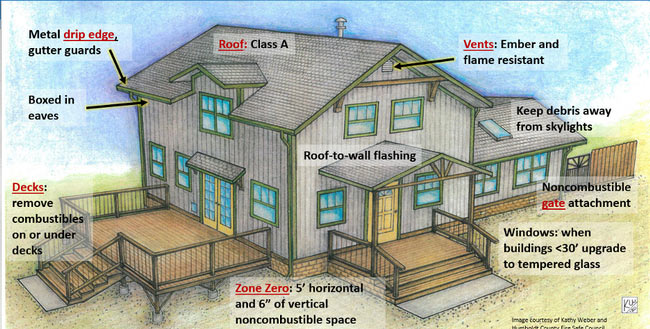
Hardening the exterior of a structure to wildfire is a key element in property protection. It is best accomplished through a combination of materials, proper installation and long-term maintenance.
Related: UC ANR: How Can We Navigate Changes in the California Home Insurance Market Due to Wildfires?
January 11, 2026 - LOS ANGELES, CA — On the anniversary of the catastrophic Southern California fires, U.S. Senators Alex Padilla (D-Calif.) and Tim Sheehy (R-Mont.), co-chairs of the bipartisan Senate Wildfire Caucus, announced bipartisan legislation to establish a new grant program to help local communities defend themselves from the growing danger of wildfires. The Community Protection and Wildfire Resilience Act would invest $1 billion annually to empower communities to implement additional science-based methods like home hardening for mitigating wildfire damage by funding new Community Protection and Wildfire Resilience Plans developed in coordination with community members, first responders, and relevant state agencies.
Representatives Jared Huffman (D-Calif.-02) and Jay Obernolte (R-Calif.-23) are leading companion legislation in the House of Representatives.
“One year ago today, Pacific Palisades and Altadena families lost loved ones, homes, businesses, places of worship, and so much more as their neighborhoods were reduced to rubble. These catastrophic disasters serve as a stark reminder that megafires can devastate both forested and urban areas,” said Senator Padilla. “That’s why I’m working across the aisle with Senator Sheehy to deliver lifesaving federal support to help mitigate the growing risk of catastrophic wildfires and harden our communities and critical infrastructure against disasters.”
“To keep American cities and towns from burning to the ground and save lives, we must be proactive in aggressively hardening communities against the year-round threat of catastrophic wildfire,” said Senator Sheehy. “The Community Protection and Wildfire Resilience Act delivers the tools needed to better safeguard people, homes, and property from disaster, and I’m proud to support this bipartisan, commonsense effort to make America more wildfire resilient.”
The new community hardening grant program would be housed within the Federal Emergency Management Agency (FEMA). The bill would also add home hardening as an allowable project under the U.S. Forest Service’s Community Wildfire Defense Grant program.
Specifically, the bipartisan Community Protection and Wildfire Resilience Act would invest $1 billion per year to:
- Establish guidelines for communities to conceptualize new Community Protection and Wildfire Resilience Plans (CPWRP) that are developed in coordination with community members, first responders, and relevant state agencies. CPWRPs will focus on implementing strategies and activities relating to:
- Improving early detection technology, public outreach and education, alerts and warnings, evacuation planning, evacuation execution, and access for first responders;
- Addressing vulnerable populations, including the elderly and those with disabilities;
- Hardening critical infrastructure and homes;
- Applying community-scale defensible space across contiguous areas;
- Building local capacity to implement and oversee the plan;
- Deploying distributed energy resources like microgrids with battery storage;
- Implementing strategic land use planning;
- Educating community members; and
- Coordinating with existing wildfire plans like a Community Wildfire Protection Plan;
- Provide grants of up to $250,000 to develop a CPWRP and grants of up to $10 million to implement a CPWRP;
- Grants will be prioritized for low-income communities that are at high risk for fire or wildfire and communities recently impacted by a major wildfire.
- Complete a report on all federal authorities and programs to protect communities from wildfires;
- Study how a CPWRP could be used as certification for insurance companies assessing community resilience;
- Continuously update wildfire hazard maps;
- Assess impediments to emergency radio communications across departments and agencies; and
- Allow for structure hardening to be covered under existing community wildfire protection programs.
The bill is endorsed by CalWild, Earthjustice, Center for Biological Diversity, Sierra Club, League of Conservation Voters, Silvix Resources, Trust for Public Land, Natural Resources Defense Council, The Wilderness Society, John Muir Project of Earth Island Institute, Los Padres ForestWatch, Wild Heritage, Unite the Parks, Alliance for the Wild Rockies, Feather River Action!, Forests Forever, Heartwood, Tahoe Forests Matter, Eco-Integrity Alliance, Friends of the Clearwater, SoCoCAN!, and Climate Communications Coalition.
“The Community Protection and Wildfire Resilience Act will promote community resilience in the places most at-risk from wildfire. We are pleased to see Representative Huffman and Senator Padilla take decisive action to address the challenges posed by climate change and fire management. We hope other members of Congress will follow their lead,” said Ryan Henson, Senior Policy Director for CalWild.
“Climate change is exacerbating wildfires, and we need to protect homes, families, and communities across the country,” said Addie Haughey, Legislative Director at Earthjustice Action. “This legislation understands that mitigating wildfire risks must be grounded in the soundest science-based methods available while providing impacted communities with the resources they need to prepare for wildfire threats. In the face of worsening wildfires, we thank Sen. Padilla for making investments in community resiliency efforts.”
“The Community Protection and Wildfire Resilience Act is common sense legislation that encourages communities to work together to reduce wildfire risk near homes and communities. In particular, prioritizing wildfire risk reduction that utilizes local workers and contractors will ensure that the economic benefits of resilience treatments flow to local communities, resulting in a win-win for people and the forest,” said Susan Jane Brown, Principal, Silvix Resources.
“The Community Protection and Wildfire Resilience Act puts the safety of lives, homes, and communities first,” said Garett Rose, Forest Project Senior Attorney at NRDC (Natural Resources Defense Council). “Instead of relying on ineffective strategies like widespread backcountry logging, this bill prioritizes proven, practical solutions such as defensible spaces, home-hardening, and community resilience efforts that meaningfully reduce wildfire risks. Ranking Member Huffman and Senator Padilla are advancing an important bipartisan science-based bill that protects communities, supports healthy ecosystems, and prepares us for the increasing challenges posed by climate change.”
“Senator Padilla’s legislation provides a real solution to the complex challenges of addressing wildlife in an era of climate chaos,” said Brett Hartl, Government Affairs Director at the Center for Biological Diversity. “It is imperative that both sides of the aisle come to the table with science and factually based solutions.”
“With the effects of the climate crisis only becoming more serious, it’s vital that we create and support fire-smart communities. From education and funding to community-scale planning, we need to make sure that the most at-risk places have the resources to help. The Community Protection and Wildfire Resilience Act will go a long way towards making our communities safer and protecting first responders,” said Anna Medema, Associate Director of Legislative and Administrative Advocacy, Forests and Public Lands at Sierra Club.
“This bill would help communities adapt to extreme wildfire, a crisis supercharged by climate change,” said Bart Johnsen-Harris, Director of Federal Climate Change Policy at Trust for Public Land. “We applaud Senator Padilla’s focus on bolstering resilience, which is critical to protecting people’s lives, their homes, businesses and communities.”
“The Community Protection and Wildfire Resilience Act is the smart, science-based approach we need to address the increasing threat of wildfire to keep our forests and communities safe,” said Michelle Gullett, Senior Government Relations Representative at The Wilderness Society. “This bill reflects the urgently needed recommendations from the 2023 Wildland Fire Mitigation and Management Commission and offers a clear roadmap to meaningfully addressing the wildfire crisis. We thank Senator Padilla for his leadership in empowering local communities, strengthening stewardship of our shared lands, and ensuring future generations inherit forests that are safer, healthier and more resilient.”
“The Community Protection and Wildfire Resilience Act embodies the crucial shift our agencies must take—moving from broad, misguided forest management strategies deep in the wildlands to a focus on defending communities and safeguarding lives. True wildfire preparedness starts with protecting homes, infrastructure, and the people who live there, not with logging far-off forests. This is the science-backed approach that saves lives and homes by emphasizing defensible space, home hardening, early detection, and community-driven planning,” said Jennifer Mamola, Advocacy and Policy Director for John Muir Project of Earth Island Institute.
In the aftermath of the catastrophic Southern California fires, Senator Padilla has introduced more than a dozen bills to help prevent and respond to future wildfires, including the Senate version of the Fix Our Forests Act, bipartisan legislation to combat catastrophic wildfires, restore forest ecosystems, and make federal forest management more efficient and responsive. Last January, Padilla introduced a suite of bipartisan bills to strengthen wildfire recovery and resilience, including the Wildland Firefighter Paycheck Protection Act, the Fire Suppression and Response Funding Assurance Act, and the Disaster Housing Reform for American Families Act. In February, Padilla introduced bipartisan legislation to create a national Wildfire Intelligence Center to streamline federal response and create a whole-of-government approach to combat wildfires. He also announced another package of three bipartisan bills to bolster fire resilience and proactive mitigation efforts, including the Wildfire Emergency Act, the Fire-Safe Electrical Corridors Act, and the Disaster Mitigation and Tax Parity Act. Additionally, Padilla and Senator Thom Tillis (R-N.C.) introduced the FEMA Independence Act, bipartisan legislation to restore FEMA as an independent, cabinet-level agency and improve efficiency in federal emergency response efforts.
A one-pager on the Community Protection and Wildfire Resilience Act is available here.
Full text of the bill is available here.
Source: Senator Alex Padilla
