


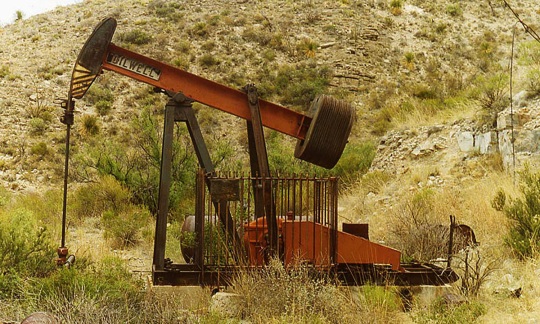
Oil Well Credit: DOI
March 4, 2026 - On Tuesday, the Coalition to Protect America’s National Parks released the following:
March 2, 2026
The Honorable Bill Groffy
Acting Director, Bureau of Land Management Department of the Interior
1849 C Street, N.W. Washington, D.C. 20240
Re: Concerns for Compliance with Mandatory Public Participation Requirements, Including for “Replacement” Oil & Gas Lease Sales
Dear Acting Director Groffy:
We, the undersigned organizations, are writing to express our opposition to the manner in which the Bureau of Land Management (BLM) is administering “replacement” oil and gas lease sales required by Public Law 119-21, the One Big Beautiful Bill Act (OBBBA).
Specifically, contrary to the Federal Land Policy and Management Act (FLPMA), the National Environmental Policy Act (NEPA), and the BLM’s own oil and gas leasing regulations, the BLM is not fulfilling its duty to engage the public in the decision-making process for these sales.
OBBBA is a sea-change in how oil and gas leasing is conducted on our public lands, and we continue to have significant concerns about many of its provisions. These provisions collectively prioritize oil and gas leasing above all other uses of public lands. BLM’s interpretation and implementation of the new law risks profound, unprecedented restrictions on access to our public lands, widespread degradation of fish and wildlife habitat, and harm to ranches, farms, and other private, split-estate lands.
Given OBBBA’s significant impact on the onshore oil and gas leasing program, it is concerning that the BLM has not yet provided guidance to state and field offices on implementing the new law. This lack of clarity limits public transparency into how these major changes are being carried out.
Further, these changes are limiting the public’s ability to inform leasing decisions, along with the BLM’s ability to act on information and concerns from the public. Unfortunately—and to the detriment of our public lands, waters, and wildlife, as well as private lands—we are seeing this play out on the ground in real-time, with the BLM informing state fish and game agencies, owners of conservation easements, and private landowners that, under OBBBA, it can no longer add needed stipulations and other protections to proposed leases.1
Without official guidance, we are also witnessing inappropriate restrictions on public participation in the context of replacement sales. Under OBBBA, the BLM must hold a replacement oil and gas lease sale if a regular lease sale is “canceled, delayed, or deferred,” or if, during a lease sale, “the percentage of acreage that does not receive a bid is equal to or greater than 25 percent of the acreage offered.” To date, the BLM has held two replacement oil and gas lease sales pursuant to OBBBA. The first was held on December 30, 2025, in Wyoming, and the second was held on January 8, 2026, in Colorado. Across both replacement sales, competitive lease bids were submitted for only two parcels totaling 160 acres—less than 1 percent of the public land acreage re-offered for leasing.
Despite there being clear statutory and regulatory requirements for the agency to do so, the BLM did not provide additional opportunity for public input for either replacement sale. In both replacement sale notices, the agency stated that parties “[could] not submit a protest because these lands were already open for comments and protests when they were first offered for lease.”2 However, 43 C.F.R. § 3120.42 clearly requires public participation for every lease sale, including a public protest period of at least 30 days.3 The regulation provides no exception for replacement sales. This provision also specifies that the Notice of Competitive Lease Sale will be made available to the public “at least 60 calendar days prior to conducting a competitive auction.”4
In contrast, the BLM Wyoming and BLM Colorado replacement sale notices were made available only 21 and 28 calendar days prior to the respective sales, and the BLM did not afford the public any further opportunities to formally weigh in on the parcels re-offered at these sales.
The fact that a protest period or other opportunity for public input was available when public land parcels were unsuccessfully offered for leasing in a preceding sale does not relieve the BLM of its legal obligation to provide such opportunities before holding a replacement sale. Although OBBBA directs the BLM to conduct a replacement sale within the same fiscal year as the original sale, it does not override the agency’s obligation under 43 C.F.R. § 3120.42, FLPMA, and NEPA to provide meaningful opportunities for public review and input on proposed leasing decisions. As explained recently by one federal court, the “public involvement requirements of FLPMA and NEPA cannot be set aside in the name of expediting oil and gas lease sales.”5 Another federal court also recently held that a protest period of less than 30 days was legally insufficient, violating the public participation requirements of FLPMA.6
The results of the two replacement sales held thus far underscore the critical need for the BLM to comply with its own rules, as well as FLPMA and NEPA, and offer additional opportunity for public participation for every replacement lease sale. With only 1 percent of the total acreage offered across the Wyoming and Colorado Fourth Quarter 2025 Replacement Sales receiving bids, the public should have been afforded the opportunity to weigh in prior to the sales, particularly to raise concerns regarding the BLM’s apparent failure to comply with FLPMA.
Under FLPMA, the BLM is required to manage public lands in accordance with the principles of “multiple use” and “sustained yield.”7 This requires that the BLM “manage[] the public lands and their various resource values so they are utilized in the combination that will best meet the future needs of the American people” and make “the most judicious use of the land.”8
Re-offering parcels for lease within one month of an original auction—particularly where there is demonstrably low industry interest—is inconsistent with these principles and undermines the BLM’s ability to obtain fair market value. It is also a profound waste of taxpayer dollars and BLM staff time that could be spent on pressing matters. Had the BLM provided additional opportunity for public input prior to the recent replacement sales in Wyoming and Colorado, stakeholders, landowners, and other members of the public could have identified these concerns, along with risks to other important resource values associated with the parcels.
As stated above, our organizations remain deeply concerned with the onshore oil and gas leasing provisions contained in OBBBA and the BLM’s implementation of them, and the harm these policy changes pose to federal public lands, waters, wildlife, and communities. We strongly oppose provisions of the new law that elevate oil and gas leasing on federal public lands above other uses, including the requirement of replacement lease sales. At a minimum, if the BLM continues to conduct replacement lease sales on public lands and mineral estate, it must fully comply with applicable laws and rules, including by providing meaningful opportunities for public input on all lands proposed to be re-offered for lease.
Sincerely,
Coalition to Protect America’s National Parks Conservation Colorado
Defenders of Wildlife
Dolores River Boating Advocates
Natural Resources Defense Council
New Mexico Wild
Rocky Mountain Wild
The Wilderness Society
Western Colorado Alliance
Western Organization of Resource Councils
Western Slope Conservation Center
Wild Connections
Wilderness Workshop
Wild Montana
Wyoming Outdoor Council
Cc: Doug Vilsack, State Director, BLM Colorado
Kris Kirby, Acting State Director, BLM Wyoming
The Coalition to Protect America’s National Parks represents over 3,400 current, former, and retired employees and volunteers of the National Park Service, with over 50,000 collective years of stewardship of America’s most precious natural and cultural resources. Recognized as the Voices of Experience, the Coalition educates, speaks, and acts for the preservation and protection of the National Park System, and mission-related programs of the National Park Service. More information can be found at https://protectnps.org
Source: Coalition to Protect America’s National Parks
