


March 13, 2026 - On Thursday, NOAA reported the following:
Key Points
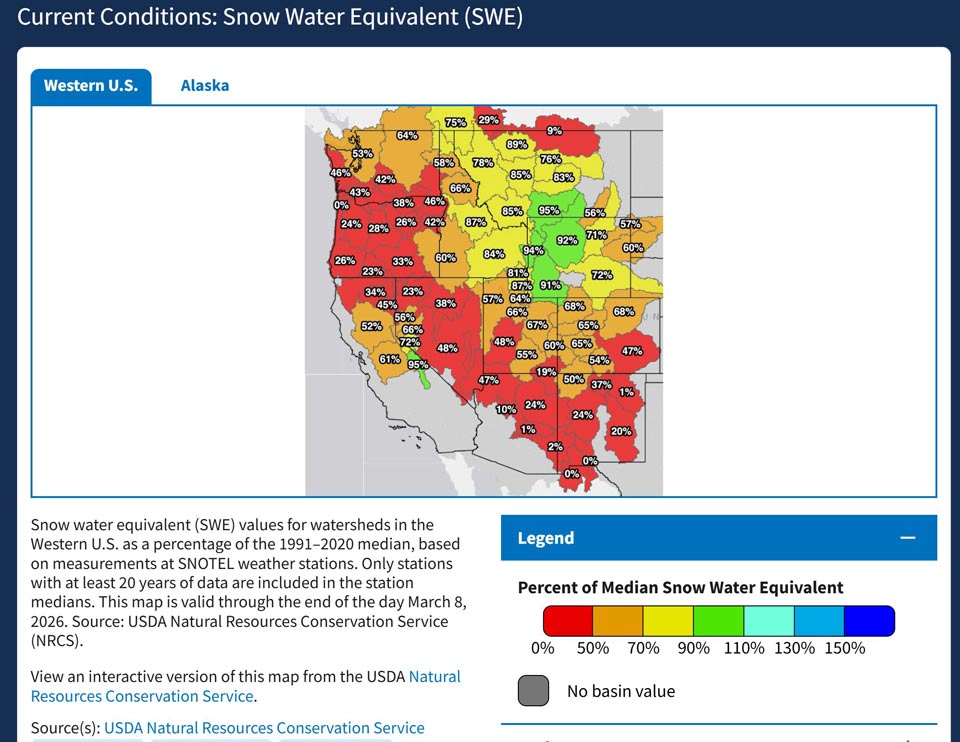
- Snow drought worsened from February into early March due to record warmth, despite near-normal precipitation across much of the West. Some locations, such as the central and northern Cascades in Washington, were also drier than normal during this period. Every major river basin and state in the West is experiencing a snow drought.
- Record-breaking high temperatures are forecasted for large parts of the West. Further, the 6-10 and 8-14 day outlooks from NOAA’s Climate Prediction Center lean toward drier-than-normal conditions for almost all of the West along with a strong probability of warmer-than-normal temperatures through March. Record-breaking snow drought conditions are expected to further deteriorate as snow melt begins much earlier for some.
- Every major river basin in the West experienced its first or second warmest winter (December, January, and February) on record. The Great Basin, Rio Grande, Arkansas-White-Red, and Upper and Lower Colorado River Basins experienced their warmest winter on record, while the Missouri and Columbia River Basins recorded their second warmest.
- As of March 8, Colorado reported record-low statewide snowpack. Stations in the Cascade Range in Oregon and Washington are reporting the greatest snowpack deficits in the West. Some states, such as California, are already experiencing an early melt out of snow.
- The Colorado River Basin reports record-low snow water equivalent (SWE).
- Basins like the Deschutes, Humboldt, Yakima, and Rio Grande continue to see snow drought conditions deteriorate.
- Snow drought impacts are occurring and are expected to worsen. Municipal and agricultural water supply concerns and restrictions are increasing.
- The Bureau of Reclamation's most probable forecast for Lake Powell shows minimum power pool elevation being reached by December 2026. If the water drops below this point, the Glen Canyon Dam may no longer generate hydroelectricity.
- The Bureau of Reclamation’s initial April–September water supply forecast for the Yakima Basin has those with pro-ratable water rights only receiving 44% of their full water allotments.
- The North Platte River Basin is under priority administration issued by the Wyoming State Engineer’s Office based on the Modified North Platte Decree.
Source: NOAA
