


In a Q&A, Yale neurologist Rebecca Blumenreich explains the common risk factors for stroke, how new technologies are making it easier to track them — and how people can reduce these risks.
June 16, 2026 - By Meg Dalton - Last year, one of Rebecca DiBiase Blumenreich’s patients had a hemorrhagic 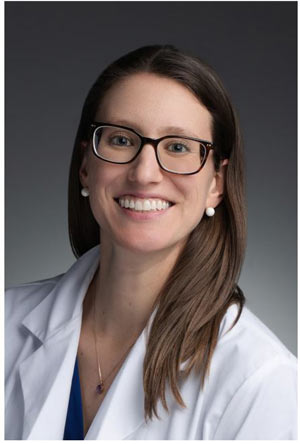 stroke. A life-threatening emergency, this type of stroke happens when a blood vessel in the brain ruptures and bleeds. For the patient, the course of treatment following the stroke was complicated; Blumenreich was with her every step of the way.
Rebecca Blumenreich Photo by Anthony DeCarlo
“When I first met her, we had a lot to go through and needed to figure out what to do going forward to make sure this didn’t happen again,” said Blumenreich, an assistant professor of neurology at Yale School of Medicine.
This particular patient ended up having a remarkable recovery. Her dexterity returned, and she even got to start knitting again. “One of the first things she did in occupational therapy was knit a pair of socks and a little hat for my newborn baby,” Blumenreich said.
As a neurologist, Blumenreich specializes in stroke rehabilitation and recovery. She often works with patients like this one in both inpatient and outpatient care, where she supports them through acute care, rehabilitation, and secondary prevention.
In an interview, Blumenreich discusses common risk factors for stroke, how to reduce risk, and the future of stroke care.
The interview has been edited for length and clarity.
What are some of the most common risk factors for stroke?
Rebecca Blumenreich: Classically, older adults are more at risk because they have more time during their lifespan to build up some of the stroke risk factors.
Stroke risk factors really dictate the people who are at risk. For example, people who have high blood pressure that is poorly controlled. It’s so common, and poorly controlled blood pressure can lead to ischemic or hemorrhagic strokes. It can lead to heart disease, which can also lead to stroke. People who have diabetes or high cholesterol are also at higher risk. People who have atrial fibrillation, which is an abnormal heart rhythm, need to have special medicines for stroke prevention. A lot of those risk factors tend to be more common with age.
What are the most effective ways to reduce risk?
Blumenreich: We’re in an exciting time because there’s been so much research coming out about stroke prevention. The same things we do to prevent stroke are also what we do to prevent heart disease and other vascular diseases. A healthy diet and exercise are the cornerstone of everything. If you can get somebody on a good exercise regimen, even just as simple as regular walks every day, that’s a huge start. When we talk about healthy diet, we’re talking about the DASH diet [Dietary Approaches to Stop Hypertension], which is basically a Mediterranean style diet. So not a lot of red meat, using olive oil rather than butter, and so on. Those are the cornerstones of stroke prevention. Once people develop some risk factors like high blood pressure or high cholesterol, you really do need to get them on medicine. There are so many great medicine options out there.
How is technology changing our ability to predict stroke risk?
Blumenreich: People are more in tune with their blood pressure and their heart rhythm nowadays because of things like the Apple Watch. So that kind of technology can be a good thing. Now I do encourage people still get a blood pressure cuff and use that even if they do have an Apple Watch. But this access to information can be really helpful and a place to start.
You’re currently involved in research projects to identify novel ways of improving and expanding access to rehabilitation for stroke survivors. What are some of the ways we can improve recovery?
Blumenreich: Most important is getting people access to physical, occupational, and speech therapy as soon as possible after a stroke. We try to limit the time that they’re in the hospital, as long as they are medically ready to leave. And we want to get them to rehab as soon as we can because we know that the faster they get rehab, the faster the brain can start rebuilding connections. That will lead to a better prognosis for stroke recovery.
What does the future of stroke care look like?
Blumenreich: The recovery realm is a big part of stroke research, and there is a lot in the pipeline. There’s a relatively newly FDA-approved device called Vivistim — which was just brought to Yale — that helps with motor recovery by stimulating the vagus nerve [a key pathway between the brain and the major organs] while the patient does therapy exercises. As time goes on, I think we’ll get more technology that we can use for stroke recovery, and then we’ll get a better sense of which specific stroke patients benefit most from which tools.
I am also Yale’s principal investigator on a trial called VERIFY [Validation of Early Prognostic Data for Recovery Outcome after Stroke for Future, Higher Yield Trials], which is aiming to establish good markers for motor recovery and prognostic measures that future stroke rehab trials can use.
One thing I’m hopeful for is that there will also be a lot of movement in the cognitive recovery realm. When we think about stroke recovery, we often think about recovery of movement because we can see when somebody’s movement gets better. But a lot of my patients have cognitive symptoms after stroke. They’ll have speech trouble, or they’ll have trouble with fatigue or trouble with depression and anxiety. Those are harder to measure, and we don’t have as many tools for those or even a good answer when patients ask how long they will last.
We need to get a better grasp on which patients tend to get those cognitive symptoms and how we can help those patients. So that’s a future direction that I’m hopeful the field will move in as well.
Source: Yale School of Medicine