


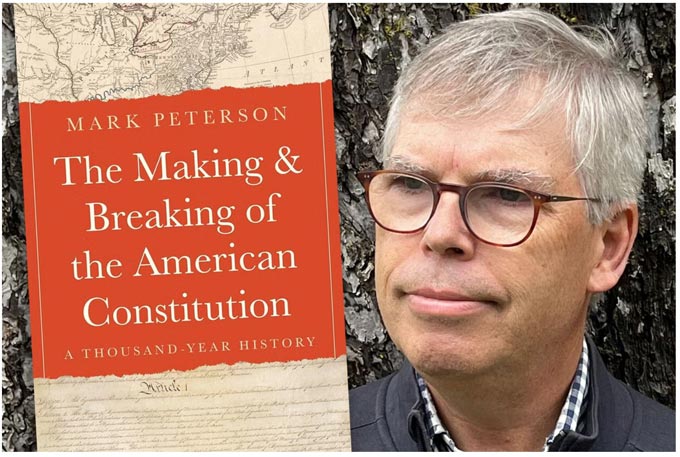
Mark Peterson Portrait by Mary Woolsey
In a new book, Yale historian Mark Peterson warns of a widening disconnect between modern American society and its Constitution.
July 13, 2026 - By Lisa Prevost - The framers of the United States Constitution called for a census to be conducted every 10 years so that legislative representation could be fairly apportioned.
But in 1913, for the first time, Congress didn’t increase the size of representation, keeping it at 435. And in 1929, they passed a law limiting the number to 435. The nation has since doubled in population, but legislative representation remains unchanged.
The result, says Yale historian Mark Peterson, is an ongoing argument over how to distribute a stagnant number of seats.
“We have created this false sense that representation is a scarce item that we have to fight tooth and nail over, when we could have as many representatives as we want,” he said.
This is just one of dozens of reasons why Peterson believes we have reached a constitutional crisis point. In his new book, “The Making and Breaking of the American Constitution: A Thousand-Year History” (Princeton University Press), Peterson argues that because the written document establishing the country doesn’t reflect the enormous societal changes of the past 250 years and the greatly expanded role of the federal government, it now restricts the possibilities for good government.
“The capacious garment of the Philadelphia Constitution, designed by American citizens in 1787 to empower an agrarian nation to transform a continent, has more recently become a straitjacket in the hands of courts, lawyers, and politicians who see the constitution as nothing but words in a written text and use the written text to prevent a modern nation from pursuing the ends its people desire,” he writes.
Peterson, the Edmund S. Morgan Professor of History in Yale’s Faculty of Arts and Sciences, sat down to talk with Yale News about why the need for land distribution made the Constitution an imperative, the long-lasting pitfalls of the Louisiana Purchase, and why we should start thinking about a constitutional makeover. The conversation has been condensed and edited.
One of the central themes of your book is that the drafting of the Constitution was driven in large part by the need for a federal mechanism for land acquisition and distribution.
Mark Peterson: Right. The Articles of Confederation [the first governing document, adopted in 1777, which was superseded by the U.S. Constitution] had been extremely successful in that it had created a nation that won a war for independence against a major world power. But with the peace treaty that ended the Revolutionary War and recognized American independence, Britain granted the United States claims to a tremendously large amount of territory — the entirety of the region west of the Appalachian Mountains, all the way out to the Mississippi. So, one of the tasks that the new United States had to take up after the treaty was figuring out how they were going to manage it. And it was urgent because there was competition for this territory, first and foremost from the Indigenous people who lived there and owned it, but also from the Spanish, who claimed Florida to the south and everything west of the Mississippi, and from the British, who were in Canada and had every reason to think that they might be able to get large amounts of it back.
But under the Articles of Confederation, the national government had very limited powers and capacities to gain control over this territory. It had no direct taxing power. And it had no executive branch and therefore no president to direct the government’s power to control the territory. It had no national judiciary system to deal with territorial disputes. Of all the various things that were challenges under the Articles, the land distribution issue was the one that demanded the kind of expansive, large-scale, tax-empowered, military-empowered executive branch of government that we got in the Constitution. And I think that’s probably the newest and most radical contribution this book makes to the history of American constitutionalism.
You emphasize just how extraordinary the ensuing expansionist effort was.
Peterson: Yes. The United States across the 19th century proceeded on this breathtaking expansionist project, taking not only everything east of the Mississippi and south of the Great Lakes, but essentially the great bulk of the continent all the way out to the Pacific Ocean. It’s a story that has very few precedents in world history. In a single century, a nation state went from a kind of coastal settlement of 4 million people to a continent-spanning nation of 64 million people.
Your term for this aggressive expansionist activity is the “Domesday Machine.” Would you explain that reference?
Peterson: The book begins in medieval England with William the Conqueror, the Norman nobleman who conquered England in 1066. Twenty years later, in order to gain an understanding of the kingdom that he now ruled, he had his agents create this massive survey of all the land in England, along with how many people and animals lived there, how much the land was worth, what it produced. That became the Domesday Book of 1086.
Now the British colonists in North America essentially set upon the project of transforming a continent that, at the time of their arrival, was nothing like medieval England. The Indigenous people who lived here owned land in ways that involved a great deal of movement and migration and owned it more as nations or tribes than as individuals. That’s not how English colonists imagined the world ought to be. So they set about making an America that looked like the England of Domesday.
I use the phrase “Domesday Machine” to talk about the ways in which the powers of the new national government, defined by the Constitution, are aligned with the explosive growth of its populations. The Domesday Machine idea is a symbolic way of getting people to think about the principal function that the United States government pursued over the course of its first century.
The Constitution — or Congress’s interpretation of it — underwent a fundamental change as the government considered the Louisiana Purchase in 1803, and the subsequent admission of states from this territory.
Peterson: One of the meta purposes of this book is to help readers understand that, despite what they’ve been taught, the Constitution is not just a document. It’s a relationship between the people and the frame of government, or governments, that rule them. The Louisiana story is an important one because it was a critical early moment in that relationship.
At the time that President Thomas Jefferson’s diplomats negotiated the purchase with Napoleon, the existing territory of America east of the Mississippi was far from fully colonized. And this diplomatic purchase was going to double its size. Jefferson was aware of the enormity of this. And he knew that he was proposing something that was beyond the Constitution. The written document said absolutely nothing about giving Congress or the president the power to do such a thing.
Jefferson looks at this and says, “There’s no way we can just do this under the powers of the Constitution. We need an amendment.” But members of his party thought, rightly, that many Americans would oppose it, so Jefferson, also a party politician, kept quiet about it. And Congress, by a majority vote, assumed to itself what just a few years before everyone had argued was a fundamental constitutional principle that required the sovereign people to express their voice. But what’s done is done. Once you create a new state, that’s forever in American constitutionalism.
And why was this such an important moment in American history?
Peterson: The most fundamental way in which the American Constitution changes over its history is by the admission of 37 states that weren’t part of the Union at the time of its creation. And as everyone involved in the making of the Constitution knew, the people who live in a state, the characteristics of that place, its economy, its population, all of these things are part of the fundamental constitution of the nation. And so, essentially, Congress usurped the power to change the nation in an extraordinary way. And that power was the trigger for the Civil War in the 19th century. The politics of the subsequent 50-some years after the Louisiana Purchase is the politics of the slave states and the free states fighting with each other as to who was going to control the next new territory that the United States gains. Every single event that leads to the Civil War is a fight over that question.
Today, you argue, the many capacities and duties of the federal government aren’t even remotely represented in the language of the Constitution. How did we get here?
Peterson: After the end of expansionism, across the 20th century, the United States as a land, as a people, economy, and society changed radically. And at the center of that change was a complete inversion of the distribution of government powers and mechanisms. For its first century through the 19th century, state and local governments did the vast majority of the governing. They collected more in taxes, and they spent more money.
The income tax amendment of 1913 allowed the federal government, for the first time, to directly tax the incomes of ordinary people. That hugely increased the capacity of the federal government to collect revenue. And then with the global crisis of the Great Depression, it became increasingly clear that only the federal government could operate with the breadth and detail necessary to address these crises of modern life. Then with the outbreak of the Second World War, the government moved into industrial production. And on and on.
Over the last 60 to 70 years of the 20th century, the United States government became the largest entity in the history of the world. It employed more people, gathered more money, spent more money. So now we have an immensely large government with all these functions that ordinary people rely on every day — from Social Security to air traffic controllers to highway systems to environmental protection. All these things that keep our society going have no clear basis or seat in the Constitution as written. Therefore, these functions that we all rely on are constantly becoming political footballs. As a written document, our Constitution hasn’t been adapted to accommodate the kind of government we have.
What can be done?
Peterson: I think that the United States needs a major constitutional reworking. And I think the people of this country have the right and the duty to do that. But I don’t think it will happen according to the rules of the 1787 Constitution. I don’t think the amendment process that document created has been workable for a very long time. So, I don’t know how that will happen. But I’ve been teaching courses on this subject for a long time, and what I say to my students is that every time one of these constitutional crises, renovations, or interventions happen, the people who are prepared with plans for going forward tend to have some decisive influence on the outcome. I very much encourage Americans of every age and every stripe to start thinking about the kind of country they would want, how it would look, how it would be structured, and start imagining ways to get there.
Source: Yale
