


Fraud Tops Republicans’ List As Trump Administration Pushes Crackdown
July 16, 2026 - Health care costs top the list of voters’ health care priorities for the midterm elections, with half (51%) of all voters and more than half of Democratic (60%) and independent (55%) voters saying the issue is extremely important for candidates to talk about, according to a new KFF Health Tracking Poll. At the same time, Trump administration statements about and actions targeting suspected health care fraud appear to be registering with Republican voters—more than half (55%) of whom say it is extremely important for candidates to discuss the issue of fraud in government health programs. 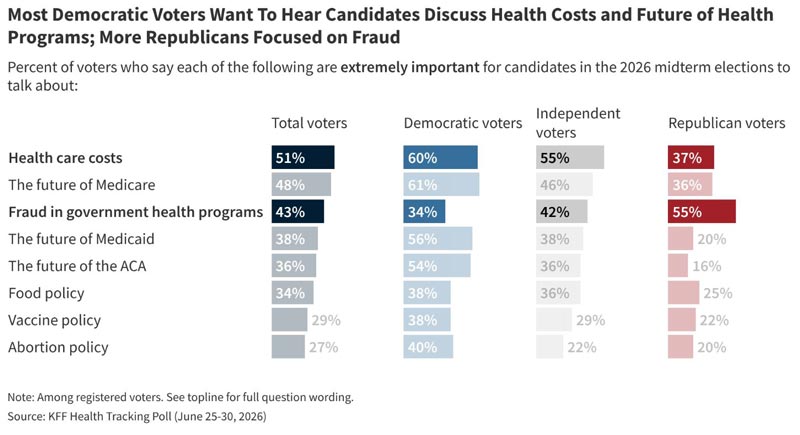
Voter Perceptions of Fraud in Government Health Programs
Most voters say there is at least “some” fraud in government health programs, but larger shares say there is fraud in other areas of government. About half of all voters say there is “a lot” of fraud in the federal tax system (52%), federal military and defense contracts (46%), and foreign aid programs (46%). Smaller shares of voters say there is a lot of fraud in Medicaid (40%), Medicare (36%), and the Affordable Care Act (ACA) Marketplaces (29%).
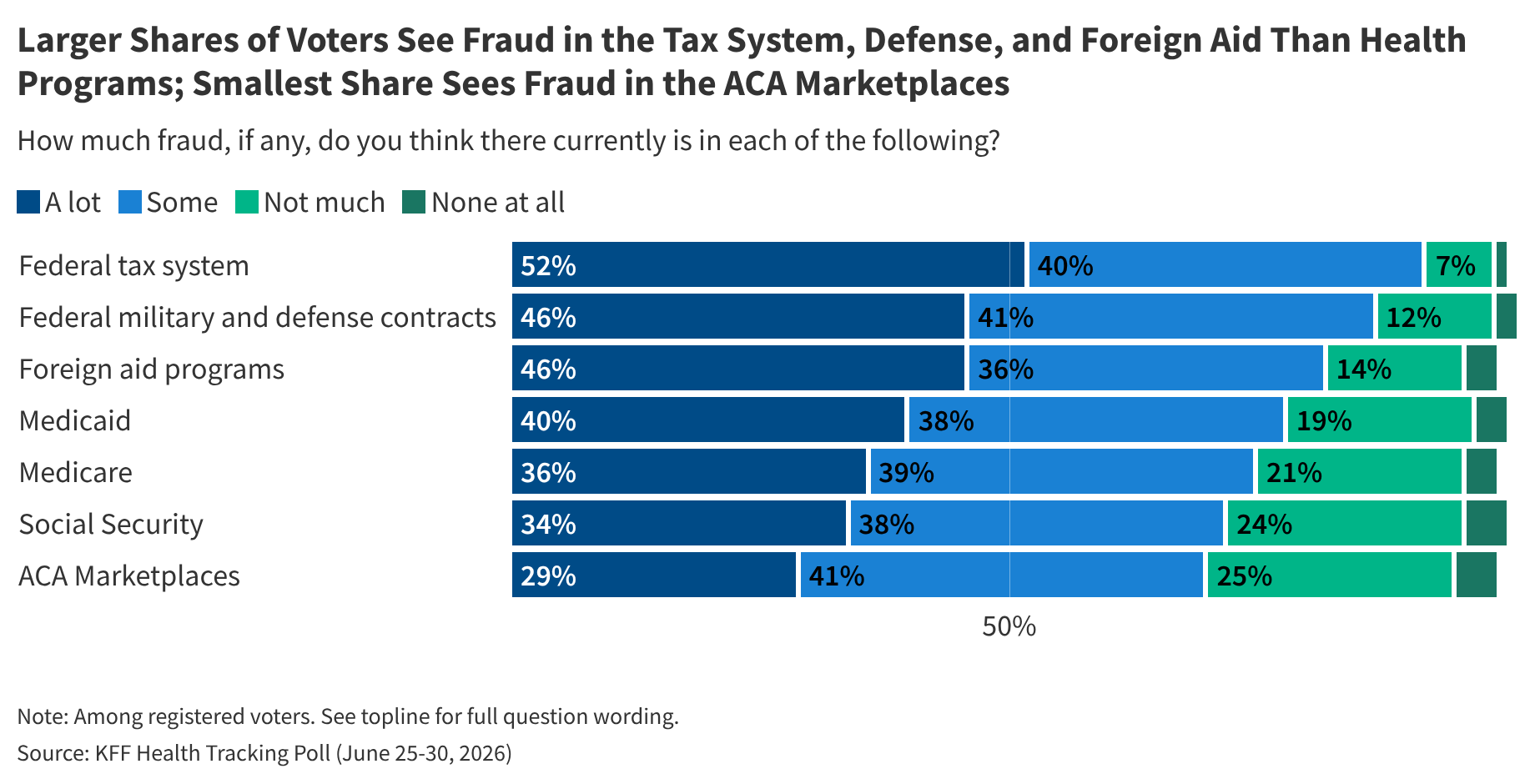
Compared to the other areas of government asked about in the survey, fewer voters (29%) say there is a lot of fraud in the ACA Marketplaces—though nearly half of Republican voters (47%) say a lot of fraud is occurring there. Trump administration officials have attributed this year’s drop in ACA enrollment to their efforts to combat fraud, rather than the expiration of the enhanced tax credits that made coverage much more costly for some Marketplace enrollees.
Partisan divisions also emerge over fraud in other health care programs, including Medicaid and Medicare, in which Republican voters are more likely (62% and 54% respectively) than both Democratic (21% and 19%) and independent voters (39% and 38%) to say there is a lot of fraud.
Across partisans, however, voters are much more likely to attribute fraud in Medicaid and Medicare primarily to health care providers, rather than individual patients, but about three in ten are not sure who is primarily responsible. About half of Democratic, Republican and independent voters say providers are mostly responsible for fraud in these programs, compared to between one in ten and three in ten who say patients are mostly responsible.
Voter Perceptions of Federal Fraud Actions in Medicaid
The Trump administration has launched sweeping fraud, waste, and abuse initiatives across all 50 states and taken targeted actions—including deferring federal Medicaid payments and decertifying fraud control units—that have so far mostly focused on Democratic-led states. Asked about the potential impact of deferred Medicaid payments, voters are much more likely to say these actions will harm beneficiaries and unfairly target states based on politics than reduce fraud or lower costs.
When asked to choose, most (71%) voters say ensuring Medicaid beneficiaries can access the care they need should be a higher priority than reducing fraud, even if it means some fraud may occur. Republican voters are closely split on this trade-off, with about half (52%) saying access to care should be a priority and half (47%) saying preventing fraud should be a priority, even if it harms access for some eligible people. Three-fourths of voters (77%) say delayed federal payments to state Medicaid programs would likely cause some eligible low-income people to lose access to health care services, including majorities of Democratic (89%), independent (81%), and Republican (61%) voters.
Nearly two-thirds of voters overall—including large majorities of Democratic (89%) and independent (70%) voters—say the Medicaid deferral approach is motivated by politics, while most Republicans (69%) say it is mostly motivated by protecting Medicaid. Meanwhile, voters are evenly split (50% vs. 50%) over whether delaying federal funding to states is likely to significantly reduce fraud, and fewer than half of voters across partisans say it is likely to lower health costs for people like them, including 46% of Republican voters and smaller shares of independent (25%) and Democratic (26%) voters.
Designed and analyzed by public opinion researchers at KFF, this survey was conducted June 25 – June 30, 2026, online and by telephone among a nationally representative sample of 1,321 U.S. adults, including 1,055 voters, in English and in Spanish. The margin of sampling error is plus or minus three percentage points for the full sample and plus or minus four percentage points for the sample of voters. For results based on other subgroups, the margin of sampling error may be higher.
Source: KFF
