


July 25, 2026 – Yosemite National Park officials announce bird banding project in the park.
Have you ever wondered how scientists study birds in Yosemite?
One important tool is bird banding, the careful process of placing a lightweight, uniquely numbered band on a bird's leg. If that bird is encountered again, researchers can learn how it moves across the landscape, how long it lives, and how healthy bird populations are over time.
A banding day begins before sunrise as biologists set up fine mist nets, which are designed to safely and temporarily capture birds. Throughout the morning, the nets are checked frequently, and each bird is carefully removed and brought to a nearby banding station.
There, researchers record information such as the bird's species, age, weight, wing condition, and overall health before placing a band on its leg. Each bird is then released to continue its day.
By late morning, the nets come down and the day's field work is complete. With 7 banding stations across an elevational gradient (4,000 ft. – 8,000 ft.) in Yosemite, the data collected helps scientists monitor bird populations, track long-term changes, and better understand how birds respond to changes in their environment. These insights help park managers make informed conservation decisions.
Yosemite’s bird banding project is part of the Monitoring Avian Productivity and Survivorship (MAPS) program, a continent-wide effort to monitor bird populations. Since the program began, more than 1,400 banding stations have operated for at least one year across the United States and Canada, contributing valuable data to bird conservation. Yosemite’s MAPS stations are operated in collaboration with the Institute for Bird Populations, National Park Service, and Yosemite Conservancy.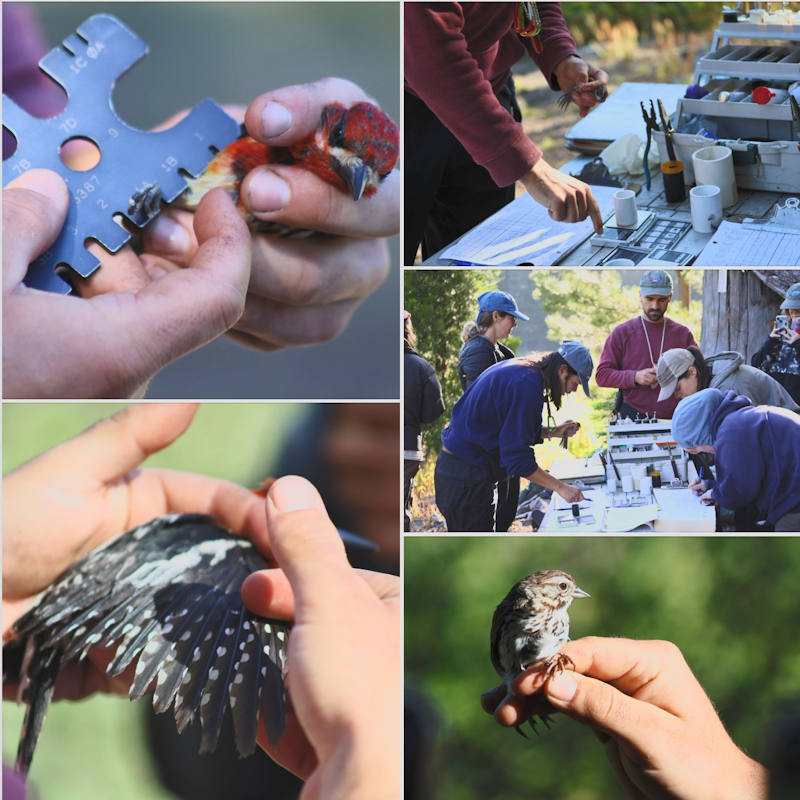
Source & photos: NPS
