


Energy Secretary Chris Wright said he prepared Trump for the consequences of military action against Iran. Americans deserve to see the plan.
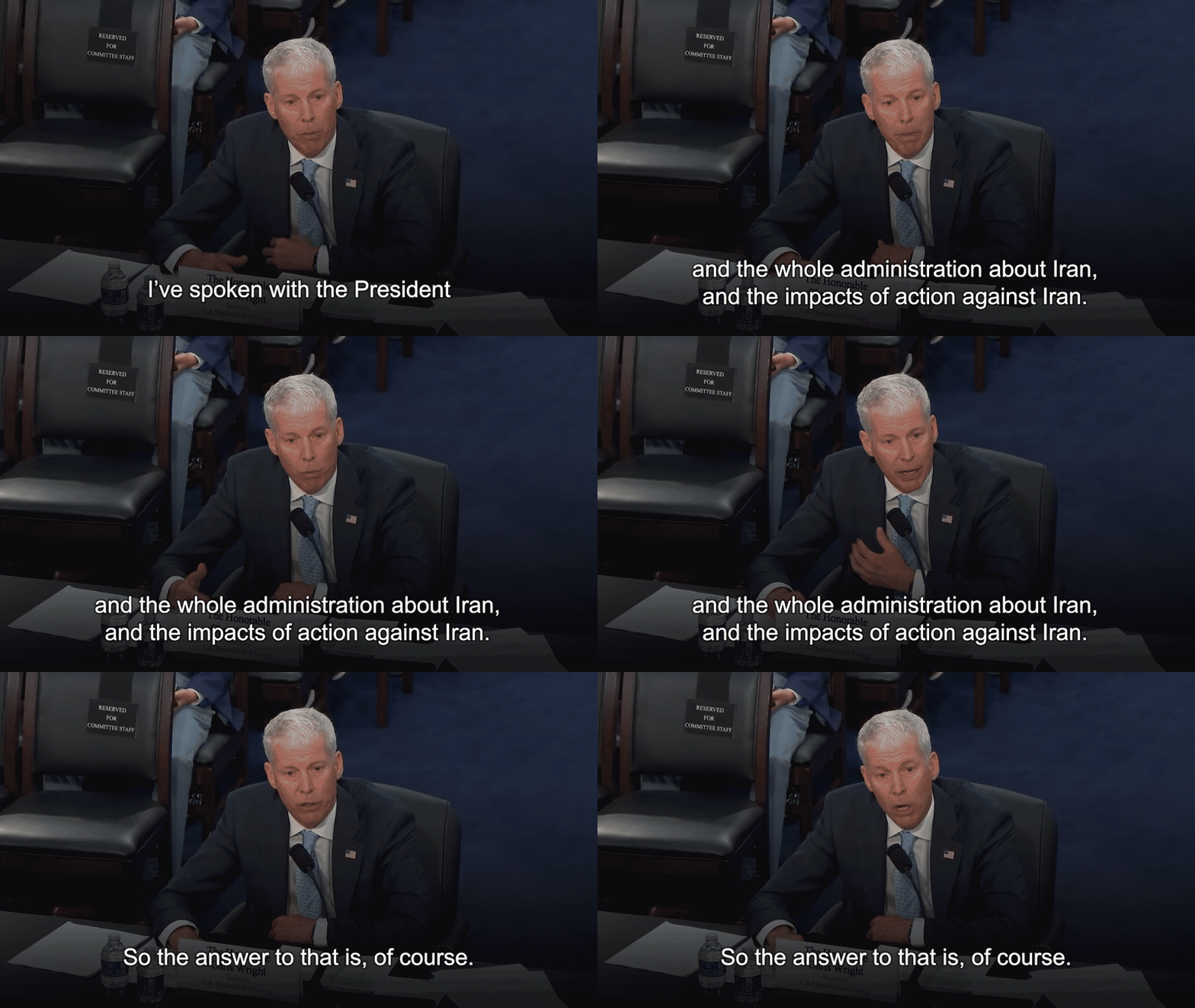
(House Committee on Appropriations hearing | April 15, 2026)
What you need to know: Governor Newsom is demanding that Energy Secretary Chris Wright disclose what warnings, planning, and advice he provided to President Trump before military action against Iran— a reckless decision that left American families and businesses exposed to severe fuel-price spikes. Nearly 200 days into the war, American households have paid more than $100 billion in extra fuel costs — over $805 per household — with no transparency from the Trump administration about what it knew, what it planned for, or what could have been prevented.
September 14, 2026 - SACRAMENTO – Governor Gavin Newsom today is demanding answers from the Trump administration about whether it had any credible plan to protect American families, workers, and businesses before Trump started his reckless war on Iran that has since sent economic shockwaves through the U.S. economy.
It has now been nearly 200 days since Trump launched, on February 28, a war on Iran without any apparent plan for the economic fallout. This past Labor Day weekend, the average nationwide price for a gallon of gas topped $4 a gallon — the most expensive in the history of the holiday, according to AAA. Last week, average diesel fuel prices reached $6 per gallon for the first time ever.
The economic risks of war with Iran were no secret: everyone knew that it risked disrupting the Strait of Hormuz and sending global energy costs soaring. Yet Californians, like all Americans, are still bearing the cost of Donald Trump’s failure to prepare for foreseeable threats to the U.S. economy. Since he launched his reckless war on Iran, families are paying more to get to work, farmers are paying more to operate, businesses are paying more to move goods, and higher costs are rippling through every part of our economy.
The Trump administration owes Americans answers about what they knew, what they did to prepare, and why they failed to protect Americans from the predictable consequences of the war.
Governor Gavin Newsom
Nearly seven months after Donald Trump launched a reckless military action against Iran, Americans have collectively spent more than $100 billion in extra fuel costs compared with what they would have paid absent the war, according to Brown University. That amounts to more than $805 in additional fuel costs per U.S. household, including more than $372 per California household.
Wright claims he advised Trump on Iran “from day one.” What did he “advise”?
As Energy Secretary, Chris Wright is responsible for protecting America’s energy security. Reporting from CNN reveals that Chris Wright was a key architect of the planning and execution of the Iran conflict. Yet President Trump’s national security team, including Secretary Wright, significantly underestimated Iran’s willingness to close the Strait of Hormuz in response to U.S. military strikes, while longstanding government and economic analysis about the consequences of such a disruption were treated as a secondary consideration. Even more troubling, reporting suggests that top Trump officials acknowledged to lawmakers during classified briefings that they did not plan for the possibility of Iran closing the strait in response to strikes. Why would they think that?!
On April 15, Secretary Chris Wright testified under oath before Congress that he had discussed Iran and the potential consequences of military action with President Trump and the administration “from the day I arrived in this seat.”
- What exactly was Wright’s advice?
- Did Wright really believe Iran would not close the Strait?
- What analysis did DOE conduct before the strikes, and who reviewed and signed off on it?
- Did Trump officials model the potential impact of a Strait closure on oil, gasoline, and diesel prices?
- Did Wright warn Trump of those consequences? If so, was his advice ignored?
- If Wright failed to warn Trump of those consequences, why did the nation’s top energy official fail to prepare for a risk that the U.S. government had planned around for decades?
The risks were not a secret
According to the U.S. Energy Information Administration, the Strait of Hormuz is the world’s most critical oil chokepoint, carrying roughly 20% of all petroleum traded globally. For decades, preventing its disruption has been a foundational principle of U.S. national security and energy policy. A 2019 Heritage Foundation report referred to the Strait as a “U.S. strategic priority.”
Prices are surging nationwide because Trump’s military strikes on Iran continue to disrupt shipping through the Strait of Hormuz, choking off the shipping lane that normally carries a fifth of the world’s oil supply. Every $10-per-barrel increase in crude translates to roughly 24 cents more per gallon, which hits drivers in Texas, Florida, California, and everywhere else. With crude costs up nearly 50% since the start of the war, the only thing that will actually stabilize global oil markets — and thus gasoline and diesel prices for American drivers and businesses — is reopening the Strait of Hormuz. But Trump has offered no plan to do that. There’s no oil rig in Texas or off the California coast that can reopen the Strait.
China Chris
At the marching orders of Donald Trump, Secretary Chris Wright has worked to block the best thing that would actually insulate American families from the next oil shock: getting off fossil fuels. Wright — a former fossil fuel executive — has gone after electric vehicles, EV charging infrastructure, the electric grid buildout, and clean energy manufacturing since joining the Trump Administration.
The rest of the world is moving in the opposite direction. The International Energy Agency’s (IEA) 2025 World Energy Investment report found that global capital flowing into renewables, nuclear, grids, storage, and efficiency is on pace to roughly double the amount going to oil, gas, and coal. The IEA also found that China is the world’s largest energy investor, accounting for nearly one-third of global clean energy investment. The IEA itself attributes China’s investment push to reducing reliance on imported oil and gas and leading emerging technology markets.
- Why is Secretary Wright working overtime to cede emerging markets to China?
- Why is Secretary Wright using government power to enrich his former industry while stalling American-made clean energy and surrendering tens of thousands of American jobs to China?
Every year Donald Trump surrenders that ground to China and other competitors is another year of jobs, American manufacturing, and long-term economic security moving elsewhere, while Americans remain more vulnerable to volatile global oil markets that can be held hostage by foreign wars.
Rising prices, oil profits, and Chris Wright’s Big Oil ties
Before joining the Trump Administration, Secretary Wright spent decades in the fossil fuel industry. As Americans face higher fuel costs amid the Iran war, Wright’s deep ties to the fossil fuel industry raise concerns, especially as oil companies report major profits while gasoline prices climb.
According to a recent Climate Power analysis, 27 oil and gas companies reported $85.2 billion in profits, a 142% increase from the same period a year earlier. That amounts to roughly $39 million an hour during the second quarter of 2026. According to a Groundwork Collaborative analysis, Big Oil is taking windfall profits and delivering them to shareholders, not American drivers.
- Does the Secretary agree with the President that higher oil prices are good for America — and does he think drivers, farmers, and truckers share in that?
- How did Secretary Wright’s decades in the oil and gas industry shape the advice he gave the President?
Trump himself has said the quiet part out loud: “When oil prices go up, we make a lot of money.”
A trail of nonsensical lies
🤥 On February 24, just days before Donald Trump ordered the Iran war, Trump took a victory lap on gasoline prices during his State of the Union address, boasting low gasoline prices. Today, Americans are left with higher costs at the pump, with working families, farmers, small businesses, drivers, and everyone else paying the price.
🤥 On February 28, four days later, Donald Trump bombed Iran with no plan to safeguard the Strait of Hormuz — a critical waterway where 20% of global oil trade passes through daily. The result: crude prices shot up, translating into higher prices on everything from gasoline and diesel to jet fuel and shipped goods.
🤥 On March 8, as gas prices spiked nationwide, Energy Secretary Wright said on CBS’s Face the Nation: “We have a temporary period of elevated energy prices, but it will not be long. In the worst case, this is weeks — this is not months, and it leads to a better place.” Today, over 3 months in, that statement stands as either a lie or a stunning display of negligence.
🤥 On March 12, as gas prices continued rising nationwide, President Trump posted on social media that “when oil prices go up, we make a lot of money” — an extraordinary admission that higher gas prices benefit his Big Oil donors while American families bear the cost.
🤥 On March 15, Energy Secretary Wright appeared on NBC’s Meet the Press and pointed to the illegal restart of the Sable pipeline off the Santa Barbara coast as proof the administration was acting. “We’ve got new oil production coming on in California,” Wright said. “So lots of actions we’re taking to mitigate this price rise.” That was a lie. Sable promised its project would “offer Californians immediate relief at the pump by making gas more affordable.” Oil from the Sable Offshore Pipeline would be a drop in the bucket — 0.05% of total oil production — that would have zero impact on lowering global oil prices.
🤥 On April 7, Trump’s own Energy Information Administration administrator admitted that fuel prices will keep rising unless there is a solution to the Strait’s closure.
🤥 On April 12, Trump confessed that gas prices “could be the same or maybe a little bit higher” by November. On the same day, he ordered a U.S. Navy blockade of the Strait of Hormuz — driving prices higher still.
🤥 On April 14, Secretary Wright accidentally let the truth slip out: “We’re going to see energy prices high and maybe even rising until we get… meaningful ship traffic through the Straits of Hormuz.”
🤥 On May 10, after spending over two months making predictions and promises about gas prices, Secretary Wright avoided price predictions as gas prices continued to skyrocket: “I don’t know the future of gas prices” — this comes after he said there was “a good chance” that gas prices would drop below $3 per gallon before the summer travel season begins. On that same day, Wright also admitted that the only solution to Trump’s energy crisis was opening up the Strait of Hormuz: “I can say that when we start to get free flow of traffic through the Strait of Hormuz, energy prices will come down.”
🤥 On June 3, after weeks of falsely stating that gas prices would go down if California just drilled more oil in the ocean, Secretary Wright admitted the truth: “It’s a global market.”
🤥 On June 5, with gas prices still remaining high, Secretary Wright bragged that the administration increased oil production after illegally using the Defense Production Act to reopen the Sable Pipeline in Santa Barbara, falsely claiming: “It grew California’s oil and gas production by 20% — just turning a valve.” He then went on to state that “lowering pump prices will ultimately take a resolution with Iran to get more oil flowing through the Strait of Hormuz.”
🤥 On June 6, Secretary Wright misled the public into believing that they were boosting oil supply by 20% after forcing an illegal oil operation to run at Sable Offshore Pipeline. Again, the truth the administration does not want Americans to know: oil from the Sable Offshore Pipeline would be a drop in the bucket — 0.05% of total oil production — that would have zero impact on lowering global oil prices. Since oil trades at a worldwide price, American crude sells to the highest bidder, not at a discount for American consumers. This is just more distraction from the real driver of gas prices.
🤥 On June 9, Secretary Wright changed his tune from March, saying that the energy crisis would be temporary; now it will take “many months” to get back to normal after this energy crisis.
🤥 On June 11, with the national average gas price still up 40% from before the war, Trump declared: “I love it. The numbers were great… I love the inflation.”
🤥 On August 15, at a New York political rally, Trump lectured Americans to accept paying “a tiny little bit more for your gasoline” as the cost of preventing Iran from obtaining a nuclear weapon.
🤥 On August 20, Treasury Secretary Scott Bessent said he did not “really understand” why oil prices had spiked as Trump’s Iran war dragged into its 6th month.
🤥 On September 6, when asked whether prices could rise further, Secretary Wright said: “I don’t want to have an opinion on that.” Let that sink in. Trump’s top energy official doesn’t have an opinion on skyrocketing gas prices nearly 200 days after he assured the American people that higher gas prices were temporary.
🤥 On September 9, Trump admitted oil prices would likely NOT begin “tumbling downward” until after the midterms, adding, “I think it’s going to take a little bit longer than the midterm.” On the same day, CNBC revealed that Trump’s oil investments have gained millions. While our brave service members are fighting overseas, Trump’s accounts keep trading.
Source: Office of the Governor
