


Saturday Update:
Yosemite National Park Dome Fire Saturday Morning Update: 4,498 Acres with 28% Containment; Glacier Point Road is Closed, Yosemite National Park is Open and Operating Normally
September 25, 2026 - Yosemite National Park Dome Fire Friday Morning Update: 4,258 Acres with 17% Containment.
| Total Personnel: | 781 |
|---|---|
| Size | 4,258 Acres |
| Percent of Perimeter Contained | 17% |
| Fuels Involved |
Standing closed canopy timber is producing active fire behavior and spotting, adjacent fuels become less continuous with scattered timber, brush, grass, and exposed granite hillsides. Red fir fuel type with montane shrub and brush understory interspersed with pockets of nonburnable fuels in granitite rock outcrops. Fir trees are large diameter and over 100 ft tall and suffer from insect and disease mortality, leading to significant snag component and large amounts of heavy dead and down coarse woody debris. Most active fire behavior has come from the dense, closed canopy red fir stands, where torching and isolated crown fire pockets have also contributed to spotting. Fuels in 2017 fire footprints have less closed canopy but contain significant dad and down with standing snags, increasing spotting potential. Montane shrubs and brush in the understory are generally available to burn but are not at critical fuel moisture levels. Heavy dead and down fuels are dry, with fuel moisture in 1,000 hr. fuel below 10%. Active burning in recent days illustrates a fuel complex that is generally available across all types and size classes. |
| Significant Events |
Active Fire Behavior was observed with isolated torching, flanking and creeping. Fire has continued to spread to the north and northeast via surface spread in heavy fuels and short to medium range spotting (between ¼ to ½ of a mile). The red fir fuel type has a significant dead and down component and is highly conducive to both ember production as well as ember reception, leading to frequent spotting. Wind alignments from the south and west increase spotting to the north and northeast, with a noteworthy large spot fire established east of Tanner meadow on the SW facing slope. The heavy fuel loading presents resistance to control issues for ground resources, reducing line production rates, though numerous granite outcroppings and bare areas provide some opportunities for using natural barriers. To the north, fire growth is expected to slow as it encounters the footprint of the 2017 Empire Fire. Threats to values at risk and potential fire behavior are greatest as the fire moves downslope to the west and southwest, where heavier mixed conifer fuels increase potential for fire behavior that would challenge ground resources. The fire remains wholly within the wilderness area of Yosemite National Park and is expected to stay that way through the forecast period. |
| Current as of | Fri, 09/25/2026 - 14:14 |
|---|---|
| Incident Time Zone | Pacific Standard Time |
| Incident Type | Wildfire |
| Cause | Human - Abandoned Campfire |
| Date of Origin | |
| Incident Time Zone | Pacific Standard Time |
| Location | North of Wawona Dome |
| Incident Commander | California Complex Incident Management Team 3, Incident Commander Oscar Vargas. |
| Incident Description | The fire has a moderate rate of spread to the north and northeast. Firefighters have been utilizing natural barriers, and line has been secured on the south and west sides of the fire. The fire is deep in the wilderness and difficult to access due to steep, rugged terrain. |
| Coordinates | 37° 33' 58'' Latitude -119° 36' 82
'' Longitude |
| Planned Actions |
Construct direct handline where topography and fire behavior permit. Establish secondary and contingency lines. Employ rotary-wing aviation assets to check fire spread, moderate flame lengths to thresholds suitable for direct attack. Continue to identify and construct helispots and sling sites to support operational mission. Establish Badger Camp within 48 hours. |
|---|---|
| Projected Incident Activity |
12 hours: Continuous backing and flanking to the west are anticipated along the northwest corner of the incident footprint. Along the northern perimeter, isolated timber stringers will perpetuate localized torching, shortrange spotting, and creeping surface fire growth. The eastern perimeter will continue flanking, with short, uphill, wind-driven runs expected in areas of continuous fuel. Overall perimeter growth will remain low. 24 hours: The continued warming and drying trend will increase fire behavior with mostly a backing fire progression; spot fires will remain the primary spread, driven by ridge-top winds and general winds in alignment with the prominent drainage. Fire behavior will predominantly manifest as a surface fire, driven by occasional spotting downwind of isolated torching in heavy fuel accumulations. Growth from spots to the north and east will continue as fire establishes in isolated timber stringers. Potential for short uphill runs and continued spotting in red fir fuels remains as fuels in drainages responds to the warming and drying trend. Northwestern flank of the fire will continue to back downslope driven by rollout and short-range spotting. No southern progression is expected, and overall perimeter growth will remain minimal during this operational period. 48 hours: Despite a forecast for lower temperatures and slightly higher relative humidity, increases in surface winds, mixing heights, and transport winds will challenge the eastern and northern flanks. Substantial natural barriers, such as rock outcroppings, will limit continuous fuel alignment; however, the strengthening wind profile will cause a marked increase in spotting potential and rate of spread. Overall containment will be challenged, though primary fire spread is expected to move away from identified values at risk. 72 hours: While decreasing temperatures and slightly higher relative humidity will provide minor moderation, fire behavior will be challenged by an increase in surface winds. Elevated mixing heights and strong transport winds will directly confront the eastern and northern flanks of the incident. While there are substantial natural barriers such as rock outcroppings, this nonetheless will create a marked increase in spotting as well as rate of spread. This will challenge overall containment; however, the primary spread will be away from values at risk. Anticipated after 72 hours: The combination of increased relative humidity, lower temperatures, and moderating wind speeds will suppress fire behavior. Activity is expected to steadily subside as the probability of precipitation increases across the incident area. |
| Weather Concerns |
Today (Thursday) is expected to be the warmest and driest day of the week as high pressure remains situated over the area. Temperatures in the mid-60s to lower 70s with minimum relative humidity falling to around 20 percent in the early afternoon before rising into the upper 20s during the mid to late afternoon. Winds were generally diurnal with occasional gusts to around 15 mph on the exposed ridges. A few clouds once again developed over the Sierra Crest. 12-Hour Overnight: Clear skies overnight with light drainage winds under 5 mph. Humidity recovery will be generally good, with readings in the 60s. Temperatures will fall into the 40s and 50s, with inversions developing after 2100. 24-72 Hour Forecast: High pressure will start to shift east Friday as a weak weather system moves into California. This will bring cooler temperatures, increasing humidity, and stronger southwest winds through the weekend. Overall, there will be increasing mid and high-level clouds, but no threat of precipitation. Temperatures will gradually fall a few degrees each day, dropping by early next week to about 15 degrees cooler—with highs in the low to mid-50s and minimum relative humidity in the 30s and 40s. Expect northeast winds overnight, shifting to southwest 8–12 mph with gusts of 20– 25 mph in the afternoon. Daily inversions will lift by mid to late morning each day. Extended (Beyond 72 hours): High pressure will start to rebuild over the region with increasing temperatures, decreasing humidity, and typical diurnal winds. No precipitation is expected into the middle part of next week |
|---|
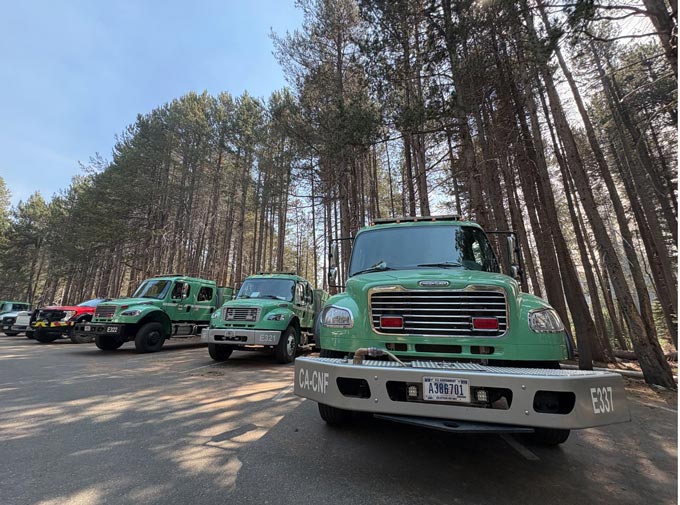
Forest Service Engine Strike Team at the Dome Fire
Previous Information
Yosemite National Park Dome Fire Thursday Morning Update: 4,034 Acres with 15% Containment; Glacier Point Road is Closed, Yosemite National Park is Open and Operating Normally
