


November 24, 2026 - By Michael Hsu - Imagine a facility that lowers the risk of severe wildfire, makes use of underused materials from forestry and agriculture, helps California reduce carbon emissions – and also generates jobs, regional economic growth and community health benefits, such as better air quality.
A biofuels and wood products campus that transforms woody biomass and agricultural residues into renewable energy can deliver all of the above. While demonstration sites have proven the effectiveness of the technology, California currently lacks commercial-scale facilities of this kind.
Two reports by UC Cooperative Extension scientists – and collaborators from Sierra Resource Conservation District and the Agricultural Technology Innovation Partnership (ATIP) Foundation – offer blueprints for models that can realize such a vision.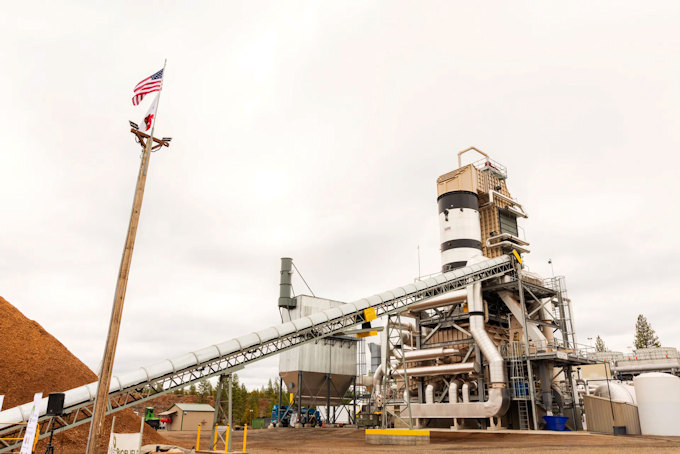
West Biofuels' Hat Creek Bioenergy facility in Burney (Shasta County) converts forest thinnings into renewable electricity connected to the local grid. The facilities studied in the two reports would have similar feedstock yards and handling equipment, but would use gasifiers to produce biofuels. Photo courtesy of West Biofuels
"When it comes to biomass utilization, there are not many references in California that can guide industry people, investors and policymakers in making decisions – where they need to invest, how much to invest, what options are appropriate,” said Cindy Chen, a co-author of the reports and UCCE woody biomass and forest products advisor for the Central Sierra.
One report looks at the feasibility of a “wood products innovation campus” that generates renewable diesel in Fresno County (PDF), and the other investigates a possible hydrogen fuel-producing campus in San Bernardino County (PDF). Both campuses would encompass a large biofuel facility, as well as smaller structures that produce other wood products.
“In terms of San Bernardino, the conclusion we reached, based on our techno-economic analysis, is that it is feasible economically to produce hydrogen from woody biomass,” said Haris Gilani, report co-author and principal investigator, and UCCE biomass and bioenergy advisor serving Riverside and San Bernardino counties.
The researchers also found that commercial production of renewable diesel was feasible for Fresno County.
“These scenarios were shown to be economically viable, so I hope that these reports will encourage more investment in these types of projects,” Chen said. “They’re not only useful for companies that could potentially make a profit from them; they also will help California communities reduce wildfires and help achieve California’s climate change goals.”
Gilani and Chen both emphasized that the models presented in the reports are meant to be replicable in other regions of the state with similar access to available woody biomass and agricultural residues.
Fresno County report: Biomass from agricultural lands, forestry, municipal waste can produce renewable diesel
Fresno County was selected for study because it sits at the nexus of multiple streams of biomass (or “feedstocks”) that can be used to produce renewable diesel. The wood product innovation campus could receive agricultural residues from a host of farm-related activities in the region (pruned branches, almond hulls, trees from orchard removal, etc.), municipal solid waste, and – crucially – the woody debris from forest operations in nearby foothills and the Sierra Nevada.
“The business-as-usual scenario is that the debris is left on the forest floor, where it either decomposes, or in the event of a wildfire, adds to the available fuel and can contribute to more intense wildfires,” Gilani said. “By removing that excess woody biomass and moving it to these proposed facilities, we can turn a potential wildfire fuel source into valuable bioenergy products.”
Through a process called gasification, the organic biomass is heated (not burned) to an extremely high temperature, producing a mix of various gases called “syngas” and solid biochar – a carbon-rich byproduct that has a growing number of applications, including as a soil amendment.
The syngas component can then be converted into renewable diesel or hydrogen fuel. Both pathways offer the potential for substantial greenhouse gas emission reduction compared with conventional fossil fuel. Based on the reports’ assessments, renewable diesel produced from biomass has about 93% lower carbon intensity than conventional petroleum diesel, while hydrogen produced from woody biomass is estimated to have approximately 59% lower carbon intensity than conventional hydrogen produced from natural gas.
“When we look at the technology readiness level (TRL), which ranges from 1 (basic research) to 9 (fully commercialized technology), integrated biomass gasification systems for producing renewable fuels are generally around TRL 7 to 8,” Gilani added.
In the Fresno County report, the authors outline a systematic process for identifying potential sites for a wood products campus using multi-criteria decision analysis (MCDA). Geographic information systems (GIS) screening was integrated with 23 criteria layers, such as the availability and density of feedstocks and proximity to transportation networks, to determine the suitability of the sites.
After eliminating locations that were near sensitive habitat areas and other protected lands, they identified 77 high-suitability sites across California, including nine in Fresno County. They chose a representative candidate – the Rio Bravo Fresno Biomass Power Plant site – for further analysis.
The researchers then modeled the performance of four feedstock mixes: 1) 100% forest residues; 2) a 50/50 blend of forest and agricultural residues; 3) a mix that introduces 20% municipal solid waste; and 4) a high (50%) municipal solid waste mix.
“Scenario one, which was 100% forest residues, demonstrated the strongest financial and operational performance in terms of the volume of renewable diesel produced and the highest internal rate of return [of investment],” said Gilani. He added that the first scenario also generated the greatest health benefit, as it significantly reduced the risk of wildfires and smoke-related health impacts.
San Bernardino County report: Repurposing existing facilities reduces capital costs by 40%
San Bernardino County was chosen for the second report because of its proximity to high wildfire-risk areas. Currently, there are limited markets and end-uses for woody biomass generated through forest thinning and other fuel-reduction treatments in the national forests across the region. That biomass – which might otherwise remain on landscapes and contribute to wildfire fuel loads – could instead be used as feedstock for a commercially viable hydrogen production facility.
“It’s very important to remove excess woody biomass in areas where it poses a wildfire risk, but it’s costly, unless we create an alternative market for what’s left on the forest floor,” Gilani said. “We won’t be able to remove it without any incentives.”
The researchers also chose San Bernardino County because of the high volume of freight traffic connecting the Port of Los Angeles to distribution centers and warehouses throughout the Inland Empire. The report envisions reducing the reliance on fossil fuels by tapping into a renewable source, hydrogen produced through biomass gasification. Replacing diesel-burning vehicles would also be a boon for a region that historically has had some of the worst air quality in the U.S.
“Heavy-duty transportation is a sector where we need to put more focus on decarbonization, and this is a great opportunity where trucks potentially would be running on a clean fuel,” Gilani said.
Recognizing that infrastructure needs present a major obstacle to creating a biomass innovation campus, the authors also studied the advantages of repurposing an existing facility. Gilani pointed out that California has a large number of idled or abandoned sites that are candidates for reuse, such as old sawmills or biomass power plants.
In the San Bernardino report, the researchers used the idled Desert View power plant in Riverside County as a case study of how “brownfield” development (building on land that was previously used for industrial or commercial purposes) can provide benefits over a “greenfield” pathway (building from scratch).
“We did the repurposing scenario and found that there’s about 40% less capital cost in using the repurposed site; you have existing buildings, infrastructures, permitting and biomass supply chains – all those factors add up,” Gilani explained, noting that reusing an existing site also can reduce risk for potential funders and accelerate project timelines.
Regulatory challenges, hydrogen market, transport of biomass remain obstacles
While a brownfield approach can expedite some aspects of developing a biomass innovation campus, such efforts still face significant regulatory barriers. Chen observes that its backers would need substantial finances to meet an array of environmental criteria, even before it can start operating and generating revenue.
“All of these scenarios face some level of policy regulation, policy restraints, regulatory permitting challenges,” Chen said. “As you know, everything [related to permitting] can take longer in California, especially when it comes to building these types of facilities.”
Another crucial barrier for companies and investors is uncertainty in the hydrogen market.
“The price of hydrogen is unstable, which I think is one of the biggest constraints,” Gilani said. “If you look at the retail price, it’s somewhere between $25 to $30 per kilogram; at that price, it’s not going to be able to compete with diesel and other heavy-duty transport fuels, despite policy incentives in place such as California Low Carbon Fuel Standard.”
According to Gilani, hydrogen currently costs approximately 2.8–3.3 times more than diesel, when purchased at public retail prices, for fueling a truck that covers the same distance.
Then there’s the challenge of moving the feedstocks to the wood product/biomass innovation campuses, which can be cost prohibitive.
“For these facilities to work and ensure the continuous production of hydrogen or renewable diesel, you need a continuous supply of biomass,” Gilani said.
One possible solution is the establishment of strategically located feedstock aggregation yards, where biomass from disparate sources can be collected.
“In this model you have long-term agreements with these ‘middle man’ entities that will receive all this feedstock from different landowners, and then they will supply the biomass facility,” Gilani explained.
If Chen and Gilani secure funding, they hope to continue their study of the biomass innovation campus project. They aim to focus next on workforce development, including a proposal to launch a training pilot program in partnership with community colleges.
The Fresno County and San Bernardino County reports were made possible by funding from the California Department of Forestry and Fire Protection. In addition to Gilani and Chen, co-authors of the reports were Md Sahadat Hossain, formerly with University of California Agriculture and Natural Resources and now a postdoctoral associate at Virginia Tech; John Heywood, Sierra Resource Conservation District; and Rick Brenner, ATIP Foundation.
Both reports are available at: https://ucanr.edu/site/woody-biomass-utilization/research-publications.
Source: UC ANR
