


June 12, 2025 - SAN FRANCISCO - A majority of Californians support downsizing the federal government, while around half support cutting US aid to foreign countries. Solid majorities oppose new tariffs on goods imported from Canada, Mexico, and China, while a majority oppose cutting environmental regulations on oil and gas drilling. These are among the key findings from a statewide survey released on Wednesday by the Public Policy Institute of California.
Full Survey Report
Asked about downsizing the federal government, a majority of Californians either strongly support (27%) or somewhat support (30%) doing so. Among likely voters, 31 percent strongly support and 26 percent somewhat support downsizing. Views vary across party lines, with Republicans (67% strongly support, 24% somewhat support) and independents (30% strongly support, 34% somewhat support) far more likely than Democrats (7% strongly support, 29% somewhat support) to approve of downsizing.
Fifty-three percent of Californians strongly support (25%) or somewhat support (28%) cutting US aid to foreign countries, while 49 percent of likely voters strongly support (25%) or somewhat support (24%) this. Views vary widely across partisan groups (Republicans: 54% strongly support, 30% somewhat support; independents: 25% strongly support, 29% somewhat support; Democrats: 9% strongly support, 24% somewhat support).
“A majority of Californians support downsizing the federal government, while around half approve of cutting the aid that the US provides to foreign countries,” said Mark Baldassare, PPIC Statewide Survey director and Miller Chair in Public Policy. “On both these issues, views vary across partisan groups.”
The new statewide survey also finds:
- One in three or fewer approve of the president, Congress, and the US Supreme Court. Majorities oppose new tariffs on Canada, Mexico, and China; four in ten support cutting back environmental regulations on oil and gas drilling. A third of Californians approve of the way President Donald Trump, the US Congress, and the US Supreme Court are handling their jobs. Twenty-nine percent of Californians (34% of likely voters) approve of President Trump’s job performance, 20 percent of both adults and likely voters approve of Congress, and 31 percent of Californians (32% of likely voters) approve of the US Supreme Court. Views of the president, Congress, and the Supreme Court all vary widely across party lines.
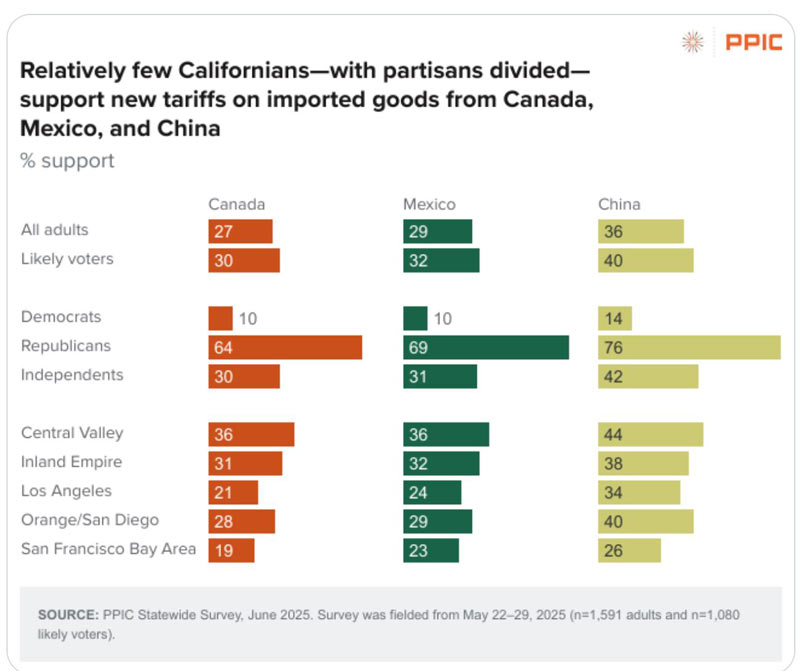
An overwhelming majority of Californians either strongly oppose (54%) or somewhat oppose (18%) new tariffs on imports from Canada (likely voters: 58% strongly oppose; 13% somewhat oppose). Similar shares strongly oppose (53%) or somewhat oppose (17%) new tariffs on imports from Mexico (likely voters: 55% strongly oppose; 14% somewhat oppose). Asked about new tariffs on imports from China, a solid majority strongly oppose (41%) or somewhat oppose (22%) (likely voters: 40% strongly oppose, 20% somewhat oppose).
Asked about cutting back environmental regulations on oil and gas drilling, nearly six in ten Californians either strongly oppose (40%) or somewhat oppose (19%) this (likely voters: 48% strongly oppose, 12% somewhat oppose).
“Three in ten Californians approve of the job performance of the president, one in five approve of the US Congress, and one in three approve of the US Supreme Court,” Baldassare said. “Most Californians are opposed to new tariffs on Canada, Mexico, and China and cutting back environmental regulations on oil and gas drilling.”
- Higher prices are a financial strain for half of Californians, and housing costs are a strain for four in ten. One in three say they are worse off financially than a year ago, and economic pessimism has risen. Half of Californians (51%) say recent price increases have caused financial strain for them or others in their household, including 16 percent who say these increases have caused serious financial hardship. Half or more of residents in the Central Valley (64% hardship, including 23% serious hardship), Inland Empire (59% hardship, including 20% serious hardship), and Los Angeles (51% hardship, including 16% serious hardship) say higher prices have caused financial hardship in their household.
Forty-one percent of Californians say that housing costs place a financial strain on their family, including 23 percent who say housing costs cause a lot of financial strain. Four in ten or more in the Inland Empire (48% financial strain, including 32% a lot), the Central Valley (45% financial strain, including 26% a lot), and Los Angeles (45% financial strain, including 22% a lot) say the cost of housing places a financial strain on their family.
One-third of Californians (33%) say that their families are financially worse off than they were a year ago, while 13 percent say they are better off, and 54 percent say they are about the same. The share saying they are worse off than a year ago varies across regions (48 Inland Empire, 37% Central Valley, 33% Los Angeles, 28% Orange/San Diego, 26% San Francisco Bay Area).
An overwhelming share (75%) expect that California will have bad times financially during the next 12 months (24% expect good times; 1% don’t know). The level of economic pessimism has increased notably since December 2024, when 56 percent said they expected bad times financially for the state (42% good times, 2% don’t know).
“Half of Californians say that recent price increases have caused financial hardships, four in ten say that housing costs are a financial strain, and one in three say they are financially worse off today than a year ago,” Baldassare said. “Most Californians expect bad economic times in the state during the next 12 months.”
- Majorities approve of many of the key strategies in Governor Newsom’s May Revision for bridging the gap between spending and revenues, but less than half think drawing on state reserves is a good idea. Majorities oppose providing health care coverage for undocumented immigrants. After reading a brief summary of Governor Newsom’s May Revision, 43 percent of adults (42% of likely voters) approve of the plan. Fifty-six percent of Californians (63% of likely voters) believe that its mix of spending cuts, loans, and funding shifts is a good idea; half or more across partisan groups (65% Democrats, 58% independents, and 54% Republicans) hold this view. At the same time, less than half (42% adults, 46% likely voters) think the governor’s plan to use state reserves to balance the budget is a good idea. Views vary across partisan groups, with 61 percent of Democrats, 37 percent of independents, and 18 percent of Republicans favoring drawing on reserves.
Asked if they favor or oppose providing health care coverage for undocumented immigrants in California, majorities (58% adults, 61% likely voters) are opposed. This marks a shift from majority approval over several years of PPIC surveys—from 2015 to 2023.
“Majorities think that the mix of spending cuts, loans, and funding shifts in the Governor’s proposed budget is a good idea, but fewer than half think that that using the state’s reserve funds is a good idea,” said Baldassare. “In a shift from recent years, majorities oppose providing health care coverage for undocumented immigrants in California.”
About the Survey
The Californians and Their Government survey is supported with funding from the Arjay R. and Frances F. Miller Foundation.
The findings are based on responses from 1,591 California adult residents. The sampling error is ±3.3 percent at the 95 percent confidence level for the total unweighted sample and ±4 percent for the 1,080 likely voters. Interviewing took place from May 22–29, 2025. For more information, please see the methodology section in the full survey report.
Mark Baldassare is statewide survey director at PPIC, where he holds the Arjay and Frances Fearing Miller Chair in Public Policy. He is founder of the PPIC Statewide Survey, which he has directed since 1998.
The Public Policy Institute of California is dedicated to informing and improving public policy in California through independent, objective, nonpartisan research. We are a public charity. We do not take or support positions on any ballot measure or on any local, state, or federal legislation, nor do we endorse, support, or oppose any political parties or candidates for public office. Research publications reflect the views of the authors and do not necessarily reflect the views of our funders or of the staff, officers, advisory councils, or board of directors of the Public Policy Institute of California.
Source: PPIC