


July 7, 2025 – Yosemite National Park offers some insight into the plant Hooker's evening primrose and its interesting 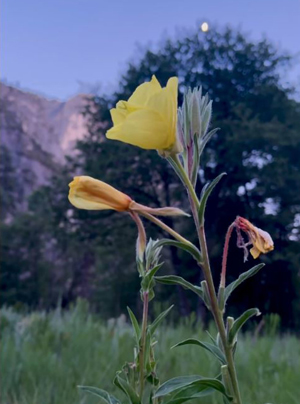 nocturnal blooming cycle.
The early bird gets the worm, but the night moth gets the rose!
As night descends over the rim of the valley and the moon comes out to play, nocturnal life is illuminated in its wake. There, in the meadows, stands a yellow beauty waiting for her cue.
Hooker's evening primrose (Oenothera elata ssp. hirsutissima) is a biennial flowering plant that starts its first year with only basal leaves. During the following year, this plant grows into its name elata, from the Latin elatus, meaning high, or elevated, as it reaches heights of up to 6 feet. Between June, the plant begins to bloom with flowers that typically open their petals only once, under nightfall.
Evening primroses are strategic with their resources, reserving pollen and nectar for nighttime pollination and typically opening only a few of their flowers each night. Though the blooming season is brief, sphinx moths arrive eagerly, using their long proboscis to sip the sweet nectar of the primrose.
While indulging, the sphinx moth may be unaware that the primrose's sticky stamens are brushing against them, transferring pollen that will aid in fertilization when they visit the next flower.
The evening primrose’s nightly performance is not to be missed, as each bloom represents both its premiere and finale. After one night spent with petals unfurled under the stars, moths dancing in their midst, the flower meets a poetic end come morning.
View video here.
Source: NPS
