


 For all women and girls.
For UNESCO, this theme speaks to the everyday realities of women and girls: the right to learn and share knowledge, to create and express themselves freely, to access reliable information, to be safe in public and digital spaces, and to participate fully in cultural, scientific and social life.
When these rights are denied or weakened, inequalities deepen and tensions grow. By acting through education, culture, science, information and communication, UNESCO addresses the root causes of these injustices, strengthens protection frameworks, and supports policies and actions that respond to the real needs of women and girls.
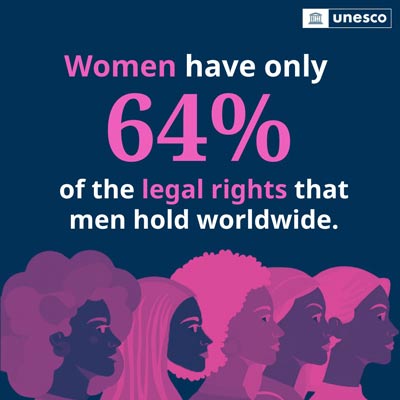
Message from Mr Khaled El-Enany, Director-General of UNESCO, on the occasion of International Women's Day.Today, in many parts of the world, women and girls are continuing to face persistent inequalities and are even seeing the roll-back of their existing rights — in access to education, employment, public responsibilities, economic resources and participation in cultural and scientific life.
These inequalities are not only unjust, but they also weaken our societies as a whole. This year, the theme of International Women's Day is "Rights. Justice. Action. For ALL Women and Girls" — a call to move beyond statements of principle.
Gender equality is one of UNESCO’s two global priorities. It cuts across all our areas of competence — education, science, culture, communication and information — because it determines the possibility of sustainable development, shared innovation and lasting peace.
We work with our Member States to ensure gender equality in education. UNESCO is thus supporting 20 countries in revising their policies, legislation and strategies, with tangible progress in places such as Mauritania, where we supported the adoption of its first national strategy for gender equality in education.
Where rights are being rolled back, UNESCO stands alongside girls and women who are denied access to education, such as in Afghanistan, where we support them with literacy classes, radio broadcasts and income-generating training. Over the next two years, we will multiply these actions through new funding from the European Union amounting to €4.7 million.
We are also working to address persistent imbalances in scientific careers. Through the L'Oréal-UNESCO “For Women in Science” Programme and the Young Talents programme, we support and promote the work of outstanding women researchers and young women doctoral students. We have also launched the gender-inclusive science institutions and systems (GenSIS) project, which includes the creation of committees for equality in science in 12 low- and middle-income countries.
With Sweden's support, we have launched a programme aimed at making cultural policies more gender sensitive. Based on an extensive study conducted in 15 West African countries, we are now running a pilot project in Senegal to improve women's access to finance and training.
Finally, in the digital age, gender equality is a major democratic issue. To ensure greater inclusion of female artificial intelligence (AI) professionals in a field that remains heavily dominated by male scientists, UNESCO has created the Women for Ethical AI Network to connect these women researchers and support their work.
On this International Women's Day, UNESCO reaffirms its commitment to working alongside all stakeholders to ensure that the rights of women and girls become a reality — everywhere and for everyone.
Source: UNESCO
