


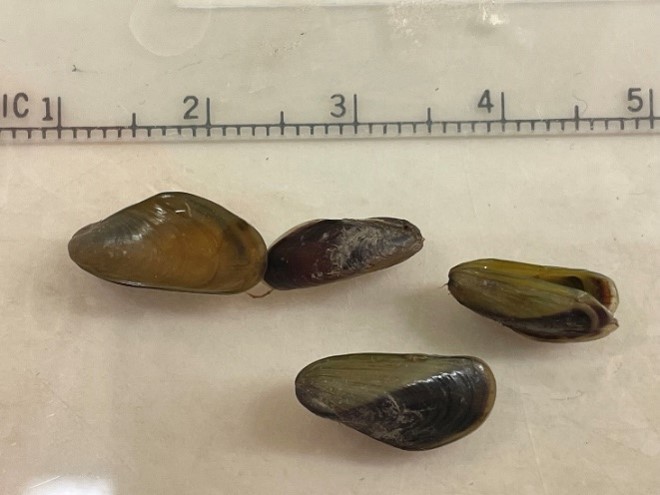
Golden Mussel Photo courtesy of the Department of Water Resources
July 8, 2026 - By Caleb Hampton - The spread of golden mussels in California has alarmed farmers this year as the invasive species established itself in waterways across much of the state.
In the Sacramento-San Joaquin Delta, the freshwater mollusks began obstructing irrigation systems that sustain billions of dollars’ worth of tree nuts, winegrapes, tomatoes and other crops.
“It’s a nightmare,” said Trey Steinhart, operations director at Zuckerman Family Farms in San Joaquin County. “There’s nothing you can do to stop them.”
Experts believe the mussels, which are native to Asia, were brought to California in the ballast water of a cargo ship. They were first detected in October 2024 at the Port of Stockton.
Since then, they have multiplied in the delta and infiltrated the State Water Project and the Central Valley Project, both of which deliver water from the delta to about 30 million people and millions of acres of farmland.
Golden mussels reproduce rapidly, growing in dense colonies on underwater surfaces and in some cases clogging infrastructure that is vital for irrigation, flood control and urban water systems.
During the past two months, impacts from golden mussels prompted Sacramento, San Joaquin and Kern counties to declare states of emergency. Last month, the city of Stockton declared an emergency after golden mussels began clogging a key water pump station, threatening a system that supplies water to residents.
“We’re just starting to see some of these huge impacts,” said Andrew Genasci, executive director of the San Joaquin County Farm Bureau. “It’s only going to get worse.”
The delta
Among the most vulnerable agricultural infrastructure are hundreds of steel pipes that siphon water from the delta into irrigation pumps and ditches.
Christopher Neudeck, president of Stockton-based civil engineering firm Kjeldsen, Sinnock & Neudeck, which represents many of the reclamation districts in the delta, said golden mussels were first found inside the siphons last year. During the past six months, he said, “an onslaught of golden mussels” began clogging some siphons and pumps that pull water from delta rivers, choking off farmers’ water supply.
“It’s now a serious problem,” Neudeck said. “We have farmers that are just cutting off their steel pipes and putting new ones on.”
Austin Loock, CEO at Delta Pump Co. in Stockton, said the company replaced at least four mussel-clogged pumps for delta farmers in recent months.
Replacing a siphon or pump can cost around $40,000. And there’s no guarantee new siphons will fare any better.
Genasci said farmers are forced to spend the money to protect investments they’ve made in their crops—in some cases hundreds of thousands of dollars’ worth of seeds, in others even more money spent developing orchards or vineyards.
“It’s a bill you can’t afford to pay, but you can’t afford not to pay,” he said. “They’re out of business if they don’t have access to water.”
Steinhart said he hasn’t been hit as hard as some farmers. None of the more than 30 siphons that supply water to his crops on McDonald Island have been clogged, he said, but they all have golden mussels in them—in some places layered two inches thick.
“It’s a major concern,” Steinhart said.
He said he was also worried about the discharge pumps that empty excess irrigation water off islands in the delta and prevent thousands of acres of farmland that lie below sea level from flooding.
If mussels clog the discharge pumps, “I would be under water,” Steinhart said.
Across the delta, replacing clogged siphons, pump stations and drainage pipes could cost farmers more than $35 million, according to an estimate Neudeck provided this year to the San Joaquin County Office of Emergency Services.
That may be only the beginning.
Farmers and water managers said they were worried microscopic golden mussel larvae, called veligers, could get past the sand media filters that are used to protect drip lines and sprinkler systems.
“They’ll just grow in your drip system until your emitters start plugging up,” Steinhart said.
Golden mussels have also begun altering delta ecosystems, experts said. As the filter feeders consume organic matter, they have enabled light to penetrate deeper into delta waters, increasing photosynthesis and worsening the growth of invasive aquatic weeds that can obstruct navigation channels and irrigation systems.
“The weeds in the delta are drastically problematic,” Neudeck said.
State Water Project
The delta isn’t the only farming region affected. Golden mussels have traveled hundreds of miles south through the California Aqueduct. During the past several months, they began appearing in water district pipelines that supply farms in the San Joaquin Valley.
In December, the Arvin-Edison Water Storage District, which provides water for 130,000 acres of citrus, table grapes, potatoes and other crops in Kern County, discovered “an extensive golden mussel situation” in its tanks and pipelines, said Samuel Blue, the district’s resource manager.
“It was pretty alarming,” Blue said.
In March, he said, the district spent $3 million on a 30-day copper-based chemical treatment, which successfully removed the mussels from district pipelines before farmers were impacted.
“Obviously, we’re still taking water that comes in from infected sources, so mussels are going to continue to come in,” Blue said. “This is going to be a long-term issue.”
Justin Rowe, general manager for Westside Water Authority and its affiliated water districts in Kern and Kings counties, said those districts have spent $2 million this year eradicating golden mussels from their systems, with that figure expected to rise to $3.8 million by the end of the year.
Rowe said farmers served by the district will need to pay more to fund ongoing treatments for golden mussels.
“We will definitely have to raise rates,” he said.
Legislation
In the delta, where irrigation water is pumped back into the estuary—and environmental protections prohibit the chemical treatments used elsewhere—farmers have resorted to targeted solutions such as copper-based paint and adhesive disks, or pucks, that send ultrasonic waves across surfaces to deter golden mussels.
“There’s a number of different ways to go about getting rid of them, but they’re all expensive,” said Genasci, the county Farm Bureau director.
The costly mussel invasion comes as many farms were already pushed to the brink by rising input costs and low crop prices.
Most experts expect that golden mussel populations will remain in the delta for years, if not indefinately.
Genasci said that if an affordable solution isn’t found to protect the region’s irrigation infrastructure, it could impact the economic viability of farms.
“This is potentially devastating,” he said. “At some point, you’re going to have to make a decision. Is it even worth throwing money at new infrastructure when you were already sitting right at break-even on your crop income?”
Genasci said government funding to reimburse costs related to golden mussels “could be a life saver for some of these delta farmers.”
Last week, Gov. Gavin Newsom approved a state budget that includes $6 million in one-time funds and $1.5 million in ongoing funding to fight golden mussels. The funding will be used to establish decontamination sites for boats and equipment.
Meanwhile, California lawmakers have introduced bills in both chambers of the U.S. Congress seeking $15 million per year through 2030 to address the crisis.
It is not clear how much, if any, of the enacted or proposed public funds would directly reimburse farmers. The federal bills propose establishing a grant program with industry partners to remove mussels from water intakes and other infrastructure.
Caleb Hampton is an editor at Ag Alert. He can be reached at champton@cfbf.com.
California Farm Bureau works to protect family farms and ranches as part of a nationwide network representing more than 5 million Farm Bureau members. Learn more at www.cfbf.com or follow @cafarmbureau on Instagram, LinkedIn, X, or Facebook.
Source: CA. Farm Bureau
