

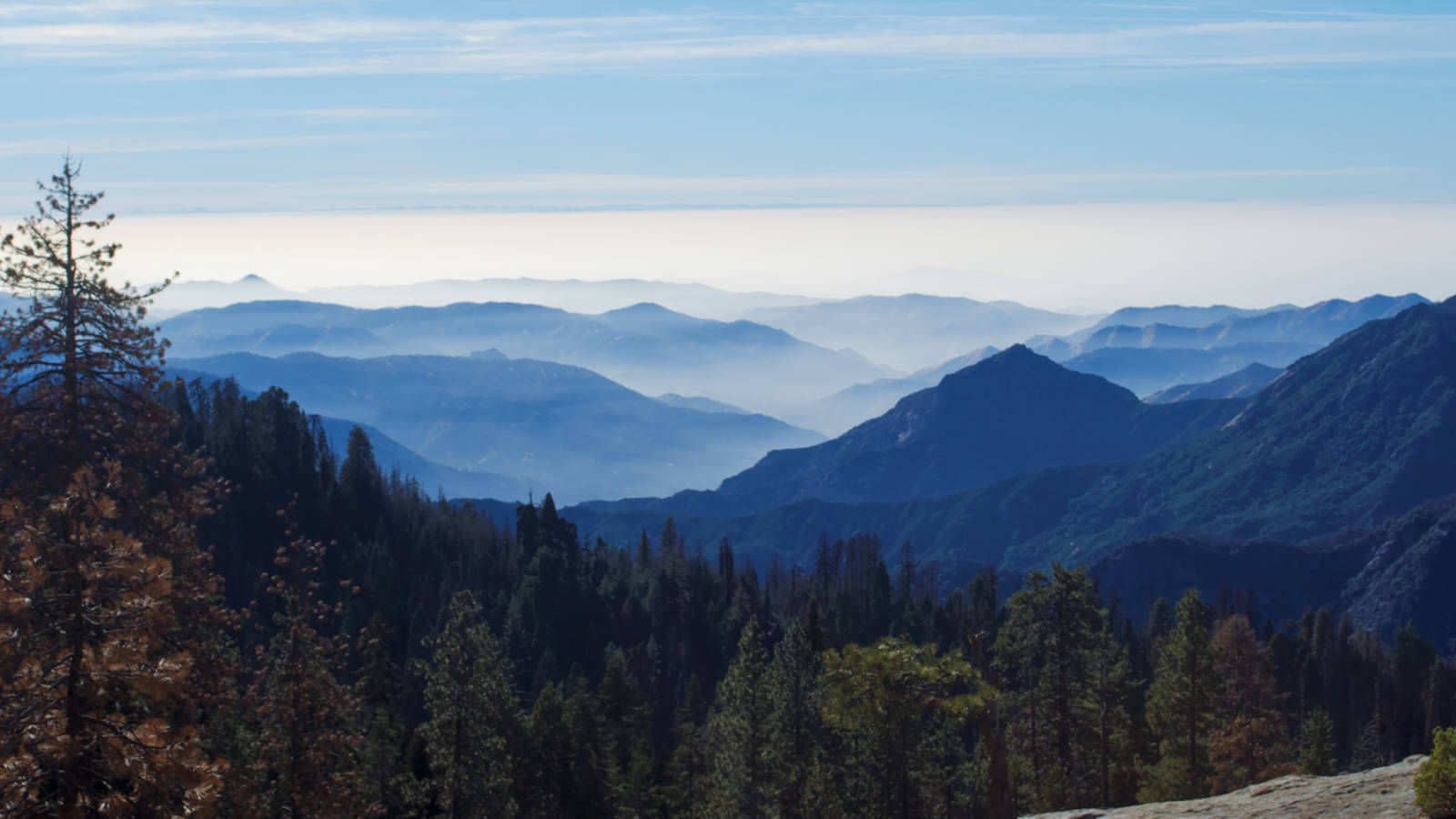
Haze shrouds Sequoia National Park
Credit: Mark Rose/NPCA
December 2, 2025 - On Monday, the Coalition to Protect America’s National Parks released the following:
Comments Submitted via regulations.gov: https://www.regulations.gov/commenton/EPA-HQ-OAR-2025-1477-0001
December 1, 2025
Paige Wantlin
Air Quality Policy Division
Office of Air Quality Planning and Standards
Environmental Protection Agency
109 TW Alexander Drive
Research Triangle Park, NC 27711
Wa***********@*pa.gov
Subject: Comments on EPA’s Advanced Notice of Proposed Rulemaking: Visibility Protection: Regional Haze State Plan Requirements Rule Revision
Dear Ms. Wantlin:
We are writing on behalf of more than 4,600 members of the Coalition to Protect America’s National Parks (Coalition), who collectively represent more than 50,000 years of national park management and stewardship experience. The Coalition studies, educates, speaks, and acts for the preservation of America’s National Park System. Among our members are former National Park Service (NPS) directors, regional directors, superintendents, resource specialists, park rangers, maintenance and administrative staff, volunteers and other supporters. We strongly support efforts to ensure that clean air and clear views are protected in our national parks across the country.
The Clean Air Act requires states to improve visibility in protected areas visited by millions of people each year to enjoy spectacular scenery, vital natural habitats, and exceptional night skies. It also requires each state to identify and evaluate the effects of industrial emissions from sources such as motor vehicles, power plants, and oil and gas operations on Class I airsheds both within and beyond their borders. Air pollution can travel hundreds of miles from its original source to national parks and communities along the way.
Some of our most iconic national parks across the country are protected as Class I areas. From the desert landscapes of Arches and Zion to the thermal features in Yellowstone, to granite peaks in Yosemite to the expansive seascape at Acadia, these national parks are treasured by Americans and worldwide visitors alike. Many of our members have dedicated decades of service to protecting these special national park sites and public lands throughout the United States. It is critical that we work together to protect these irreplaceable resources for current visitors and future generations.
We appreciate the opportunity to comment on EPA’s Advanced Notice of Proposed Rulemaking: Visibility Protection: Regional Haze State Plan Requirements Rule Revision.https://www.federalregister.gov/documents/2025/10/02/2025-19280/visibility-protection-regional- haze-state-plan-requirements-rule-revision." role="button" aria-pressed="false" aria-describedby="mfn-content-00000000000008700000000000000000_48679-1" style="word-break: break-word; box-sizing: border-box; background-color: transparent; text-decoration: none; transition: 0.5s; color: blue;">1 Our comments are overarching and not specific to any of the three broad topic areas enumerated in the Notice. Overall, we urge EPA to ensure that any revisions or changes to the Regional Haze Rule safeguard: 1) the Rule’s primary goal to reduce visibility impairing pollution in Class I areas and 2) the requirement for states to make continued, reasonable progress toward natural visibility in Class I areas. We know that the Regional Haze Rule has worked to clear haze pollution from Class I areas – Great Smoky Mountains has increased visibility by nearly 40 miles over the last two decades. But there is still much work to do as no Class I areas has achieved the Clean Air Act goal of natural visibility and park visitors are still missing out on over 50 miles of scenic views.
We are concerned that EPA is suggesting numerous “alternative approaches” for implementing the Regional Haze Rule that run contrary to the text and purpose of the Clean Air Act. For instance, we’ve already seen EPA implement a “new policy” that reverses EPA’s longstanding position that the “uniform rate of progress” (URP) is not a safe harbor and states must make reasonable progress towards the goal of remedying visibility impairment.2 This “new policy” violates the Clean Air Act’s plain language and procedural requirements and is further suggested as an “alternative approach” to utilize in the future. Moreover, we’re concerned that many of the “alternative approaches” will allow states and industrial facilities to evade cleaning up controllable haze pollution and will eliminate requirements for states to develop regular regional haze plans.
We strongly urge EPA to safeguard the Regional Haze Rule for current and future planning periods to ensure our most treasured places are preserved and protected for current and future generations.
Thank you for considering our input on this important issue.
Sincerely,
|
Philip A. Francis Jr. Leon Folsom Julia Thomas McNamee Bob Krumenaker Eric Burr Robert Love David Donohue Mike Wrigley Edward P. Walzer Jonathan Halpern Mary Riddle Cornell Edie Ramey Haydn J McLean Valerie Naylor |
Cliff Kevill John Apel Helen Scully Don Dollar Melissa Axtman Janis Kozlowski Dave Neumann Charnetta Hensley Pete Nigh Tonnie Cummings Rebecca Mills Rebecca Jones Rick Erisman John Reynolds |
Anne Cully Oron Bass Stephen Gibbons Paul Kennard Jerry Case Sarah Hubbell Carl Stapler William Hall Ries Collier Pamela Fanoele Cynthia Sequanna Randi Smith Nike Stevens Kenneth Apschnikat |
The Coalition to Protect America’s National Parks represents over 3,400 current, former, and retired employees and volunteers of the National Park Service, with over 50,000 collective years of stewardship of America’s most precious natural and cultural resources. Recognized as the Voices of Experience, the Coalition educates, speaks, and acts for the preservation and protection of the National Park System, and mission-related programs of the National Park Service. More information can be found at https://protectnps.org
Source: Coalition to Protect America’s National Parks
