


December 9, 2025 - SAN FRANCISCO - An overwhelming majority of Californians predict bad economic times for both the state and nation in the coming year. Most believe that democracy is not working as well as it was five years ago. Affordability—measured by perceptions of housing burden and the price of food and consumer goods—remains a central concern for many state residents. Overwhelming majorities favor extending federal tax credits for health insurance that are set to expire at the end of the year. And most oppose the deployment of national guard troops to California cities for law enforcement purposes. These are among the key findings from a statewide survey released on Monday by the Public Policy Institute of California.
Full Survey Report
Vast majorities of Californians expect bad times financially in the state (71%) and nation (75%) in 2026. Ominously, three in four Californians (74%) say they expect mostly periods of widespread unemployment or depression in the US during the next five years. Strong majorities across all demographic groups and regions of the state hold this view, as do most Democrats (89%), independents (74%), and likely voters (69%). Only Republicans express optimism: 60 percent expect good times, while 38 percent foresee widespread unemployment or depression.
What’s driving this gloomy outlook? One obvious factor: concerns about costs. Two in three Californians (65%) say housing affordability is a big problem in their part of the state. Forty-five percent say that housing costs place a financial strain on them and their families (25% a lot, 20% a little). Nearly nine in ten residents say they are personally very (46%) or somewhat (41%) concerned about the price of food and consumer goods in the country today. And most say they are less comfortable making a major purchase such as a home or car (76%) than they were six months ago. Strong majorities across all regions, demographic groups, political parties, and income brackets share this sentiment.
“Californians are deeply pessimistic about the economy and their own pocketbooks as we head into a pivotal election year,” said Mark Baldassare, PPIC Statewide Survey director and Miller Chair in Public Policy. “Affordability is a key issue. Overwhelming majorities of likely voters in competitive congressional districts expect economic bad times ahead (73%), are concerned about the price of food and consumer goods (96%), and are less comfortable making household purchases than they were six months ago (67%).”
More key findings:
- Growing concerns about democracy, potential for political violence. A record-high share of Californians express dissatisfaction with the way democracy is working in the US. Seven in ten state residents (71%) say they are not satisfied with democracy in the US today, compared to 52 percent in October 2022. Partisans are divided: most Democrats (84%) and independents (70%) say they are dissatisfied with the nation’s democracy, while 55% of Republicans say they are satisfied. Asked whether democracy in the US is working better or worse than it was five years ago, an overwhelming majority of Californians (71%) say it is worse today.
In the wake of recent political violence, Californians anticipate more to come. Sixty percent think there will be an increase in political violence in the US in the next few years. The percentage of residents expressing this view has risen 20 points since February 2022 (40%), when the survey last asked this question. The share of Californians who predict escalating political violence in the next few years rises with education and income. Californians are also increasingly cynical that Americans with different political views can come together and work out their differences: 74 percent today say they are pessimistic that this can happen, compared to 63 percent one year ago.
“Californians see volatile and potentially violent times ahead for our democracy,” Baldassare said. “Given these fears, it’s not surprising that they choose political extremism or threats to democracy as the most important problem facing the nation today.”
- Disagreement with feds over health care tax credits, national guard deployments, and ICE. The federal budget bill signed into law last month did not extend enhanced federal premium tax credits for the Affordable Care Act (ACA) marketplace; these tax credits are set to expire at the end of 2025 unless Congress acts to continue them. Overwhelming majorities of Californians (70% adults, 70% likely voters) believe that Congress should extend the tax credits. Strong majorities across demographic groups and regions support an extension; partisans are divided (89% Democrats, 68% independents, 33% Republicans).
Following news about National Guard deployments to Washington, DC, and other cities, about two in three state residents (68% adults, 66% likely voters) say they oppose deploying troops to a California city for law enforcement efforts. When asked about immigration policy, strong majorities of Californians (72% adults, 67% likely voters) disapprove of the job the US Immigration and Customs Enforcement agency (ICE) is doing. Majorities (58% adults, 59% likely voters) also say they approve of recent protests against ICE actions. Republicans (80%) overwhelmingly disapprove of anti-ICE protests.
Approval ratings for President Trump and Congress remain low: 25 percent of Californians and 29 percent of likely voters approve of the way President Trump is handling his job; fewer approve of the US Congress (18% adults, 19% likely voters). How do Californians feel about their own representative in the House? One-third approve. Only three in ten (29%) say they approve of the US Supreme Court.
“Californians remain out of sync with federal leaders and their policies,” Baldassare said. “Views of state officials are rosier: majorities of adults (54%) and likely voters (56%) approve of the way Governor Newsom is handling his job, and about half (51% adults, 53% likely voters) approve of the job the state legislature is doing.”
- Early enthusiasm for voting in mid-term congressional elections; Katie Porter holds lead in gubernatorial race. At this early point in the 2026 election cycle, what are we hearing from California voters? When it comes to congressional elections, a majority of likely voters (56%) and specifically Democrats (72%) say they are more enthusiastic than usual about voting next November. If the election for the US House of Representatives were held today, 63 percent of likely voters say they would vote for the Democrat. Since October 2024, likely voters in Orange/San Diego have shifted significantly toward the Democratic candidate (from 52% in October 2024 to 66% today); other regions show no significant change. A strong majority of likely voters (65%) say they prefer that Congress is controlled by Democrats.
“Californians have been focused on the 2026 congressional races since this fall, when they passed Proposition 50 to authorize temporary changes to the state’s congressional maps,” Baldassare said. “Majorities of likely voters say the outcome of the special election was mostly a good thing (62%) and worth the cost to the state (56%).”
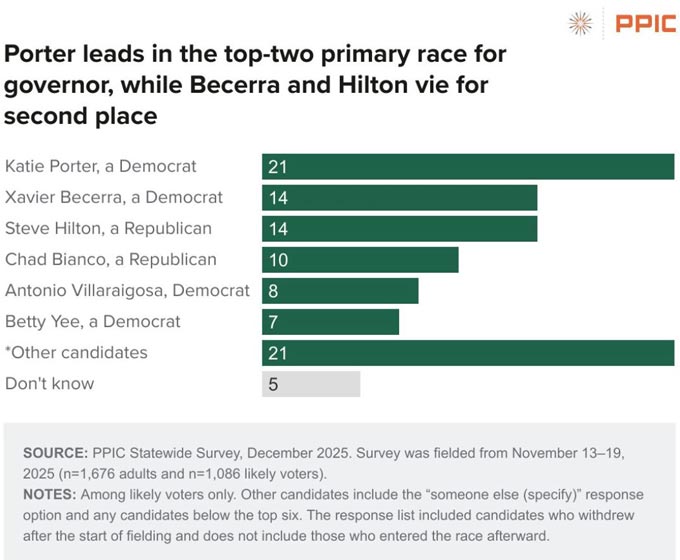
In the race for governor, 36 percent of likely voters say they are following news about the gubernatorial election. Currently, Democrat Katie Porter leads the race (21%), followed by Democrat Xavier Becerra (14%) and Republicans Steve Hilton (14%) and Chad Bianco (10%). A majority of likely voters (54%) would prefer the next governor to pursue different policies from Governor Newsom’s, while 45 percent would like to see a continuation of his policies.
About the Survey
The Californians and Their Government survey is supported with funding from the Arjay R. and Frances F. Miller Foundation.
The findings are based on responses from 1,676 California adult residents. The sampling error is ±3.2 percent at the 95 percent confidence level for the total unweighted sample and ±3.9 percent for the 1,086 likely voters. Interviewing took place from November 13–19, 2025. For more information, please see the methodology section in the full survey report.
Mark Baldassare is statewide survey director at PPIC, where he holds the Arjay and Frances Fearing Miller Chair in Public Policy. He is founder of the PPIC Statewide Survey, which he has directed since 1998.
The Public Policy Institute of California is dedicated to informing and improving public policy in California through independent, objective, nonpartisan research. We are a public charity. We do not take or support positions on any ballot measure or on any local, state, or federal legislation, nor do we endorse, support, or oppose any political parties or candidates for public office. Research publications reflect the views of the authors and do not necessarily reflect the views of our funders or of the staff, officers, advisory councils, or board of directors of the Public Policy Institute of California.
Source: PPIC
